
If you’ve heard that AI is about to replace your video production team, you’ve heard wrong. AI-driven video production explained simply is this: a set of technologies that handle the repetitive, time-consuming parts of video creation so your team can focus on strategy and storytelling. At Kickervideo, we’ve watched this shift closely across 18 years in B2B video production. The tools available in 2026 are genuinely impressive, and the marketers who understand how to use them are producing more content, testing more ideas, and spending less time on manual post-production than ever before.
Table of Contents
- Key Takeaways
- AI-Driven Video Production Explained: Core Technologies
- How AI improves video editing for marketing teams
- Operational benefits of AI in video production
- Implementing AI video workflows in your team
- My honest take after 18 years watching video production change
- See what an AI-assisted video workflow looks like in practice
- FAQ
Key Takeaways
| Point | Details |
|---|---|
| AI assists, not replaces | AI handles repetitive tasks so your creative team focuses on strategy, brand direction, and quality review. |
| Multiple AI modalities exist | Text-to-video, image-to-video, and avatar-driven video each serve distinct use cases for marketing teams. |
| Editing time drops dramatically | AI-assisted editing can cut manual editing hours by up to 90%, freeing teams for higher-value work. |
| Workflows need structure | A six-stage repeatable workflow keeps AI video production consistent, on-brand, and cost-efficient. |
| Human creativity stays central | Combining human judgment with AI execution produces marketing-grade results that full-AI autonomy rarely achieves. |
AI-Driven Video Production Explained: Core Technologies
Understanding what AI video tools actually do starts with knowing the main production modalities. These are not interchangeable. Each serves a specific purpose, and choosing the wrong one wastes time and budget.
Text-to-video generation creates video content from written prompts using diffusion models. You describe a scene in plain language, and the system generates motion, lighting, and composition. This works best for original concept content where you need visuals that don’t exist anywhere yet. The tradeoff is subject consistency. If you need the same character or product to appear across multiple scenes, text-to-video struggles to hold that consistency reliably.
Image-to-video animation solves that consistency problem. You provide a static image and the AI adds controlled motion. This works well when you have approved product shots, headshots, or brand visuals and want them brought to life without a full shoot. According to how AI video generators work in 2026, image-to-video is the strongest modality for maintaining subject integrity across a video sequence.
Avatar-driven synthetic video generates presenter-style content from AI avatars reading your script. This is practical for corporate communications, internal training, and product explainers where on-camera talent is either unavailable or cost-prohibitive at scale.
Beyond these three, multimodal inputs are expanding quickly. Google’s Gemini Omni enables high-quality video creation from combined text, image, and audio inputs, with conversational iteration built in. Instead of manipulating a timeline, stakeholders can describe what they want changed and the system responds accordingly.
| Modality | Best Use Case | Key Advantage | Main Limitation |
|---|---|---|---|
| Text-to-video | Original concepts, brand storytelling | Creative freedom | Low subject consistency |
| Image-to-video | Product demos, brand assets | Maintains subject integrity | Requires quality source images |
| Avatar-driven | Corporate comms, training videos | Scalable presenter content | Limited emotional range |
| Multimodal (Gemini Omni) | Iterative stakeholder review | Conversational editing | Still emerging technology |
Pro Tip: Match the modality to your deliverable before you start. Using text-to-video for a product demonstration where your actual product needs to appear consistently will cost you multiple revision cycles. Start with image-to-video if subject accuracy matters.
How AI improves video editing for marketing teams
Once footage or generated scenes exist, AI video editing tools take over the most labor-intensive parts of post-production. For marketing teams managing high content volume, this is where the practical time savings become real and measurable.
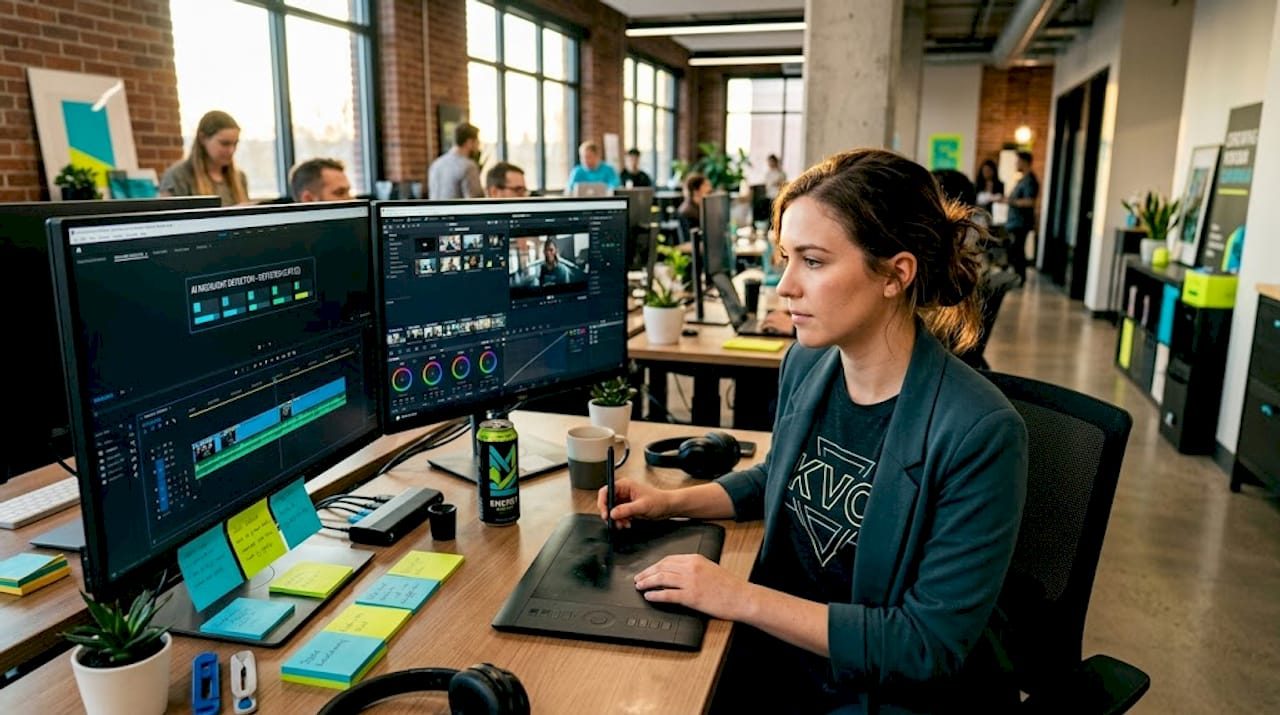
AI platforms now automate rough cuts by analyzing transcripts and identifying highlight moments. Instead of an editor scrubbing through hours of interview footage, the system surfaces the best soundbites based on engagement signals and keyword relevance. Color correction, white balance adjustment, and audio noise reduction are similarly automated. These tasks used to require either skilled attention or outsourced specialists. Now they happen in the background while your team does something else.
The more significant development for marketing editors is natural language video editing. Runway’s Aleph 2.0 lets you describe a targeted edit in plain language and applies that change across a multi-cut video while preserving the original motion and timing. You can swap a background, change a color grade, or adjust camera framing without touching the underlying clip. You preview before committing, which prevents costly generation runs on changes you might reject anyway.
Here are the editing tasks AI handles well today:
- Automated transcript generation and rough cut assembly from long-form recordings
- Speaker isolation and background noise reduction in audio tracks
- Color matching and white balance correction across multiple clips
- Caption generation with 97%+ transcript accuracy for accessibility compliance
- Platform-specific reframing and aspect ratio reformatting for social media
- Scene detection and chapter marking for long-form video content
- Variant generation for A/B testing different intros, calls-to-action, or visual styles
Captions deserve specific attention. Beyond accessibility, captioned videos perform better across LinkedIn, Instagram, and YouTube. AI platforms handle this automatically, and the accuracy rates now meet professional broadcast standards in most cases.
Pro Tip: When writing prompts for video-to-video editing models, specify both what must change and what must stay the same. “Change the background to a clean white studio while keeping the speaker’s position and motion identical” produces far more precise results than “change the background.” The system needs to know the boundaries.
Operational benefits of AI in video production
The benefits of AI in video production extend well beyond editor time savings. For marketing teams, the most significant shift is what happens to speed-to-market and content volume.
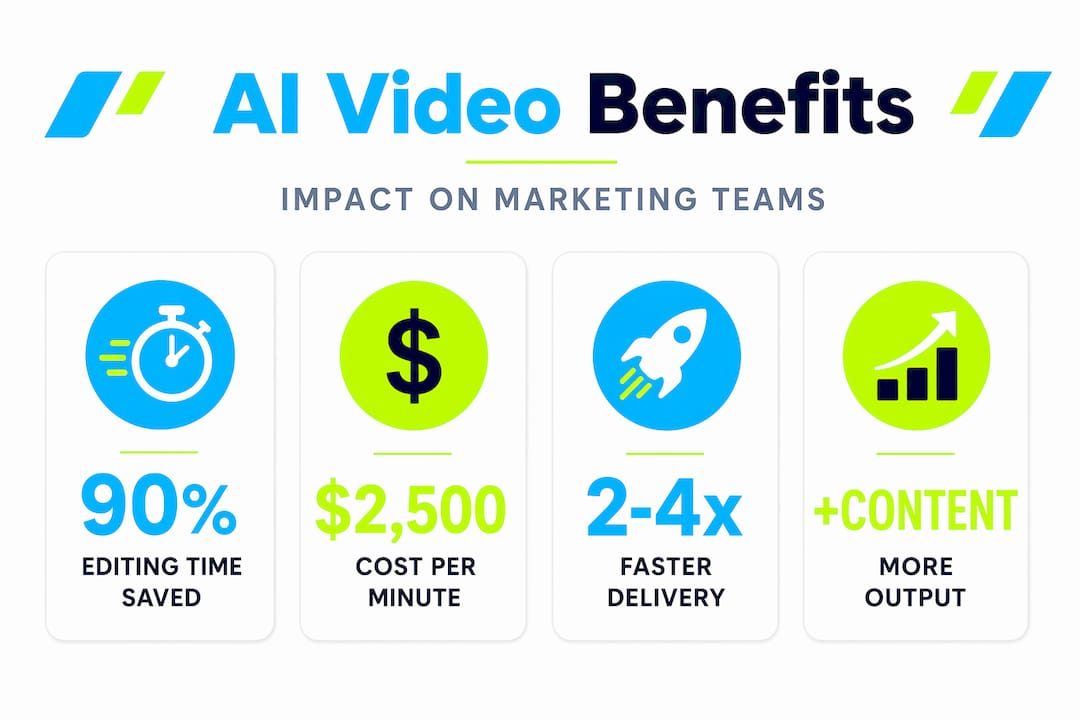
Traditional video production from brief to finished asset often runs two to four weeks. Scripting, shoot scheduling, post-production, review rounds, and final delivery stack up quickly. AI-assisted workflows collapse that timeline. A social media clip that once took a week of editing can be ready in hours. A product variant for a paid ad campaign that previously required a reshoot can be generated from an existing clip using a prompt.
Video production costs have dropped from approximately $4,200 to $2,500 per finished minute as AI enters the workflow. But the more meaningful shift is strategic. Instead of producing one polished hero video per campaign, teams can now produce five to ten variants, test which performs best, and scale the winner. That’s a fundamentally different approach to creative strategy.
AI-assisted editing reduces manual editing time by up to 90% in documented cases. A 60-minute podcast that once required four to eight hours of editing time now yields multiple ready-to-publish clips in under 30 minutes.
| Metric | Traditional Production | AI-Assisted Production |
|---|---|---|
| Time from brief to delivery | 2 to 4 weeks | 1 to 3 days |
| Cost per finished minute | ~$4,200 | ~$2,500 |
| Variants per campaign | 1 to 2 | 5 to 10+ |
| Manual editing hours per clip | 10 to 20 hours | 1.5 to 2 hours |
| Caption accuracy | Manual review required | 97%+ automated accuracy |
These numbers matter for marketing leaders making budget and resource decisions. More content, faster, at lower cost per unit. That changes how you plan campaigns and how you justify video investment to leadership.
Implementing AI video workflows in your team
Having access to AI video editing tools is one thing. Building a repeatable production workflow around them is another. Most marketing teams that struggle with AI video production aren’t using the wrong tools. They’re missing the structure that makes those tools consistent.
A reliable AI video marketing workflow moves through six stages:
- Planning: Define the objective, platform, target format, and success metric before generating anything. AI does not replace strategic thinking.
- Scripting: Write the script with your brand voice. AI can assist with drafts, but human review keeps messaging on point and legally sound.
- Scene generation: Select the appropriate modality (text-to-video, image-to-video, or avatar) and generate initial assets using precise, detailed prompts.
- Assembly: Use an efficient editing process to arrange generated scenes, add music, graphics, and branding elements through your editing platform.
- Refinement: Apply AI-driven color correction, audio cleanup, and caption generation. Use natural language editing for targeted changes rather than full regeneration.
- Export and distribution: Format for each platform automatically and schedule or publish.
This six-stage workflow gives teams a repeatable rhythm. Many marketing teams run this as a weekly production cycle, batching similar content types together to reduce context-switching and compute costs.
Human roles do not disappear in this model. Creative strategy, brand direction, legal review, and quality control remain firmly in human hands. AI execution paired with human creative judgment is what produces marketing-grade results consistently.
Building a prompt library by content type is one of the highest-return investments your team can make early. Document what works for product demos, testimonials, thought leadership clips, and paid ads separately. Prompts that work well are organizational assets.
Pro Tip: Batch your AI editing sessions. Most AI video platforms meter usage by computation, not by project. Running 15 small edits in separate sessions costs significantly more than batching those edits into one focused session. Discipline here directly controls your monthly platform spend.
My honest take after 18 years watching video production change
I’ve been in B2B video production since before social media was a distribution channel. I’ve watched every “this changes everything” moment. Most of them were incremental. AI video production in 2026 is not incremental.
What surprises me most isn’t the technology itself. It’s how many marketing teams are still treating AI tools like a faster version of the old workflow instead of a structural shift in how content gets made. You don’t use AI to do what you used to do faster. You use it to do things at volumes and speeds that weren’t previously economical.
The uncomfortable truth is that AI output quality is variable. You will get genuinely strong results, and you will get results that need significant human intervention. Learning to use speed as your advantage means accepting that some generated assets won’t be perfect and iterating quickly rather than laboring over each one. The teams winning with AI video right now are the ones who have internalized that mindset.
What hasn’t changed, and won’t change, is that creative strategy is the difference between video content that performs and video content that gets ignored. The marketer’s role is shifting toward creative director of an AI-powered production system. That’s a more interesting job, not a lesser one.
— Kicker
See what an AI-assisted video workflow looks like in practice
At Kickervideo, we’ve spent 18 years building video production processes for B2B marketing teams. We integrate AI-assisted tools into production workflows that are already built around brand consistency, stakeholder review, and measurable performance.
If your team is producing less video than your strategy actually requires, or if production timelines are slowing down campaign execution, the answer isn’t always more headcount. Our B2B video production workflow is built to help marketing teams scale content output without sacrificing quality or brand control. We also cover the full business case for video investment if you’re building internal justification for expanding your video program. Let’s talk about what your production pipeline could look like with the right structure behind it.
FAQ
What is AI-driven video production?
AI-driven video production uses artificial intelligence to generate, edit, and optimize video content. It covers tools for text-to-video creation, automated editing, caption generation, and natural language-based post-production changes.
Can AI video tools fully replace a video production team?
No. AI handles repetitive production tasks well, but human judgment remains critical for creative strategy, brand direction, and quality review. Full-AI autonomy consistently produces average results.
How much time can AI save in video editing?
AI-assisted editing can reduce manual editing time by up to 90%. A project that previously took 10 to 20 hours can be completed in under two hours with the right tools and workflow.
Which AI video modality works best for B2B marketing?
It depends on your content type. Avatar-driven video suits corporate communications and training. Image-to-video works for product content requiring subject consistency. Text-to-video fits original concept and brand storytelling content.
How do I control costs when using AI video platforms?
Batch editing sessions rather than running separate jobs for each small change. Most AI platforms meter by computation, so grouped sessions cost significantly less than frequent individual requests.