
Data-driven video production is the process of using analytics, behavioral data, and AI-powered tools to create video content precisely tailored to audience preferences and measurable campaign goals. Unlike traditional video production, which relies heavily on creative intuition and broad demographic assumptions, this approach treats every production decision as a testable hypothesis backed by real evidence. For marketing professionals and content creators, that distinction is the difference between guessing what resonates and knowing it before the camera rolls. Kickervideo has spent 18 years watching this shift reshape how B2B brands communicate, and the results consistently favor teams that build data into their workflow from day one.
What is data-driven video production and why does it matter?
Data-driven video production is defined as a production methodology where audience data, engagement analytics, and AI tools directly inform creative decisions at every stage, from concept through distribution. The industry also refers to this as algorithmic video optimization or data-informed content strategy, and both terms describe the same core principle: replace guesswork with evidence.
Every frame is optimized based on historical and real-time data, including color palette choices driven by industry engagement data and voiceover timing synced to customer sentiment. That means your creative team is not starting from a blank page. They are starting from a map.
The importance of this approach becomes clear when you consider scale. Netflix, for example, produces multiple trailers tailored to different audience demographics and viewing histories, using algorithmic data to shape promotional content in real time. What works for a subscriber who watches documentaries differs from what works for someone who streams action films. The same logic applies to your B2B campaigns, where a CFO and a marketing director watching the same product video have different priorities and respond to different signals.

What types of data inform video content decisions?
The strength of any data-informed video strategy depends on the quality and variety of data feeding into it. Relying on a single data source, such as basic demographics, produces videos that are slightly better than guesswork. Combining multiple data types produces videos that feel personally relevant.
The most useful data categories include:
- Demographic and psychographic data: Age, job title, industry, and values help define the audience segment. For B2B video, firmographic data (company size, revenue, sector) adds another layer of precision.
- Viewer engagement metrics: Watch time, drop-off points, replay behavior, and click-through rates reveal what is working inside the video itself. AI tools can detect when 50% of viewers exit within the first 10 seconds, allowing real-time adjustments to cut speed, color grading, and CTA placement.
- Sentiment analysis: Social listening tools and review data map how your audience feels about specific topics, products, or competitors. That sentiment directly informs tone, word choice, and visual style.
- Real-time trending data: Hashtag performance, search volume spikes, and market trend signals tell you what your audience is paying attention to right now, not six months ago when the campaign brief was written.
Pro Tip: Connect your CRM data to your video analytics platform before production begins. Knowing which customer segments have the highest lifetime value lets you prioritize video content that speaks directly to their specific pain points.
These data sources shape concrete production decisions. Sentiment data might tell you to lead with empathy rather than product features. Drop-off analytics might reveal that your intros run 15 seconds too long. Trending data might shift your script toward a topic your audience is actively searching for this week.
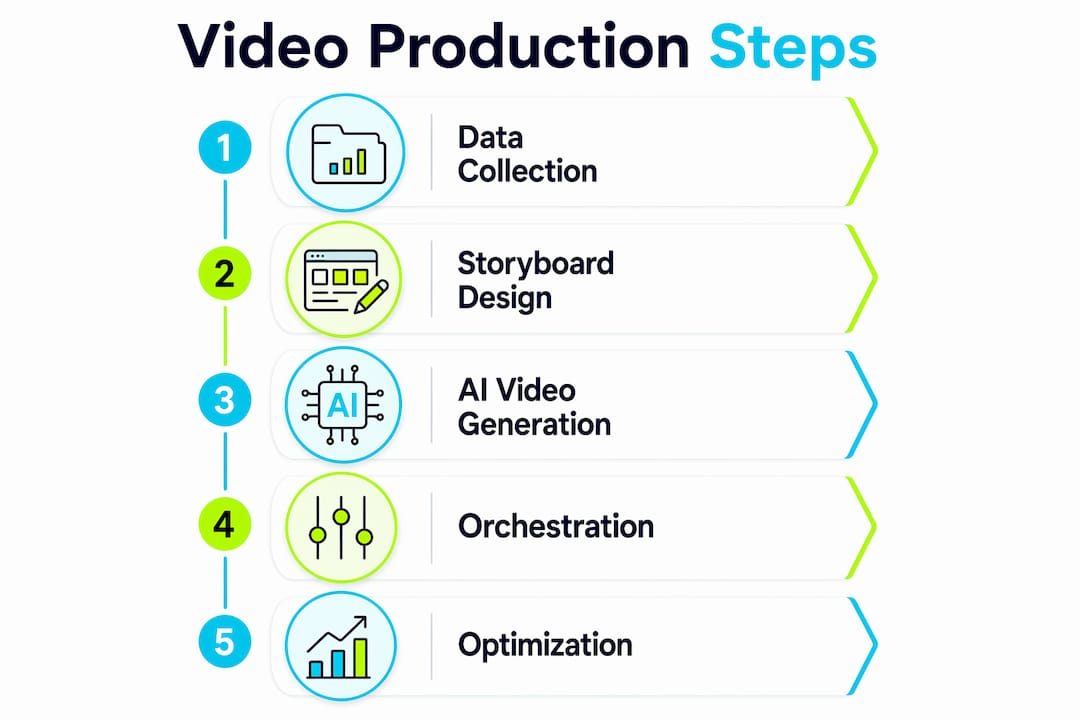
How do AI and technology power the production workflow?
Understanding the technology behind data-driven video production helps you make smarter decisions about where to invest and where to cut costs. The most effective approach treats the production stack as three distinct layers working together.
The storyboard layer
Visual ambiguity resolved at the storyboard layer before generation reduces costly retries and accelerates production. This means using data insights to pre-visualize scenes with enough specificity that the AI generation layer receives clear, unambiguous prompts. Tools like Storyboarder and Boords help teams translate data insights into shot-by-shot plans before any rendering begins.
The AI video generation layer
AI video generation models accept multimodal inputs, including reference images, audio cues, and existing footage, to produce new video content at scale. Pricing varies significantly. Google’s Veo 3.1 costs $2.50 per 10 seconds of 1080p output, while Kuaishou’s Kling 3.0 costs approximately $0.50 for the same duration. The cheaper model is not always the better value. A model that requires five retries to produce one usable clip costs more than a premium model that delivers on the first attempt.
The orchestration layer
Data orchestration agents manage continuity across video clips, preventing visual drift and maintaining brand consistency across multi-scene productions. This layer handles reference frame management and multi-scene planning, which reduces errors and speeds delivery for complex campaigns.
| Production layer | Primary function | Key benefit |
|---|---|---|
| Storyboard | Pre-visualize scenes using data insights | Reduces generation retries and ambiguity |
| AI video generation | Create footage from multimodal inputs | Scales content production efficiently |
| Orchestration | Manage continuity and brand consistency | Prevents visual drift across scenes |
Pro Tip: Evaluate AI video tools on cost per usable output, not cost per second of generated footage. A layered production approach can reduce cost per usable clip from $5.00 to $1.50 without switching to a cheaper model.
Deep Video Complexity Analysis (DeepVCA) adds another layer of pre-production intelligence. By analyzing spatial and temporal complexity before editing begins, DeepVCA helps teams forecast rendering time, bitrate requirements, and storage needs, reducing costly rework and improving output quality.
Why does data-driven video outperform traditional production?
The benefits of data-driven videos are measurable, and the gap between data-informed and traditional production widens as campaigns scale. Three advantages stand out consistently.
Precision targeting reduces wasted spend. Dynamic Creative Optimization (DCO) enables micro-segmentation down to individual households, adjusting ad narrative and tone within milliseconds based on behavioral data. That level of personalization was impossible without data infrastructure. It improves brand engagement and conversion rates because the viewer sees content that reflects their specific context, not a generic message built for the broadest possible audience.
Automation compresses production timelines and costs. A global media company saved $10 million by automating video metadata processing with AI-driven video intelligence, condensing 40 analyst-years of work into 16 weeks while processing 16 million shots across 45,000 hours of content. That is not a marginal efficiency gain. It is a structural change in how video operations run.
Real-time data enables iterative improvement. Traditional campaigns are fixed at launch. Data-driven campaigns improve after launch. When analytics show that viewers are dropping off at the 30-second mark, you adjust the pacing. When A/B tests reveal that one thumbnail drives 40% more clicks, you scale that version.
“Data-driven video production transforms marketing from generic campaigns to tailored experiences, where every production decision is grounded in evidence rather than assumption.”
You can explore how professional video drives ROI in B2B contexts to see how these principles translate into real campaign results.
What are practical steps to create data-driven videos?
Building a data-informed video strategy does not require a complete overhaul of your existing workflow. It requires adding structured decision points where data replaces assumption.
-
Define campaign goals and success metrics first. Before collecting any data, specify what you are measuring. Completion rate, click-through rate, lead generation, or brand recall each require different video structures and lengths.
-
Gather and integrate diverse data sets. Pull demographic data from your CRM, engagement data from past video campaigns, sentiment data from social listening tools like Brandwatch or Sprout Social, and trending topic data from Google Trends or SEMrush. The intersection of these data sets reveals your highest-value content opportunities.
-
Use storyboard tools to translate data into production plans. Data insights mean nothing until they shape specific creative decisions. If engagement data shows your audience responds to problem-solution formats, build that structure into your storyboard before scripting begins.
-
Select AI video tools based on your quality and cost requirements. Match the generation model to the complexity of the output. High-visibility brand videos justify premium models. Internal training content may not. Pair your generation layer with an orchestration tool to maintain consistency across scenes.
-
Monitor performance with real-time analytics during distribution. Platforms like Vidyard, Wistia, and YouTube Analytics provide viewer-level engagement data that reveals exactly where attention drops. Use that data to inform the next production cycle, not just to report on the current one.
-
Run structured A/B tests on key video variables. Test thumbnail images, opening hooks, CTA placement, and video length separately. Each test produces data that improves the next version. This is how video campaigns optimize toward higher ROI over time rather than plateauing after launch.
Pro Tip: Start your A/B testing with the first five seconds of your video. Analytics consistently show that the opening hook determines whether viewers stay or leave, making it the highest-leverage variable to test first.
Key takeaways
Data-driven video production delivers superior engagement and ROI because it replaces creative assumption with evidence at every stage of production, from data collection through real-time campaign optimization.
| Point | Details |
|---|---|
| Definition matters | Data-driven video production uses analytics and AI to inform every creative decision, not just distribution. |
| Layer your technology | Storyboard, generation, and orchestration layers together reduce cost per usable clip significantly. |
| Diverse data wins | Combining demographics, engagement metrics, and sentiment data produces more precise audience targeting. |
| Measure cost correctly | Evaluate AI tools on cost per usable output, not per-second generation price. |
| Iterate after launch | Real-time analytics enable campaign improvements that traditional fixed-production methods cannot match. |
Data and creativity are not opposites
After 18 years producing B2B video at Kickervideo, the question I hear most often from marketing teams is some version of this: “If we let data drive the decisions, do we lose the creative edge that makes our brand distinctive?”
The honest answer is that data does not replace creative judgment. It focuses it. When you know from engagement analytics that your audience drops off after 45 seconds, you are not constrained. You are freed from spending three weeks debating video length in a conference room. That time goes back into the creative work that data cannot do: finding the right story, the right voice, the right emotional beat.
What I have seen go wrong is when teams treat data as a permission slip for safe, formulaic content. Algorithmic decision-making increases financial predictability but risks diluting creative diversity. The brands that win with data-driven video are the ones that use data to sharpen their creative instincts, not replace them. They test boldly, learn quickly, and iterate with purpose.
The most effective data-informed video strategies I have worked on share one characteristic: the creative team and the analytics team are in the same room from day one. Not handing off deliverables to each other. Actually building the campaign together, with data and creativity informing each other at every step.
— Kicker
How Kickervideo supports your data-driven video strategy
Kickervideo builds B2B video production workflows designed specifically for marketing teams that need measurable results, not just polished content.
With 18 years of B2B production experience, Kickervideo integrates data insights directly into the production process, from pre-production planning through post-launch performance analysis. Your campaign goals and audience data shape every creative decision, so the final video is built to perform, not just to impress. Whether you are starting your first data-informed campaign or scaling an existing video program, the B2B video production workflow at Kickervideo gives your team the structure and expertise to turn data into content that drives real engagement and ROI. You can also explore video personalization strategies to see how advanced audience targeting translates into stronger campaign performance.
FAQ
What is data-driven video production?
Data-driven video production is a methodology that uses audience analytics, behavioral data, and AI tools to inform creative and production decisions at every stage of the video creation process. The goal is to produce content that is precisely matched to audience preferences and campaign objectives.
Why does data-driven video work better than traditional production?
Data-driven video outperforms traditional production because it replaces broad assumptions with specific evidence, enabling precise audience targeting, real-time performance optimization, and iterative improvement after launch. Dynamic Creative Optimization, for example, adjusts ad narrative and tone at the individual household level based on behavioral data.
What data sources are most useful for video production?
The most effective data sources include CRM demographic data, viewer engagement metrics from platforms like Vidyard or Wistia, social sentiment analysis from tools like Brandwatch, and real-time trending data from Google Trends. Combining these sources produces the most precise audience targeting.
How do AI tools reduce video production costs?
AI tools reduce costs by automating repetitive tasks, minimizing retries through better storyboard planning, and scaling content production without proportional increases in labor. A layered production approach using storyboard, generation, and orchestration tools can reduce cost per usable clip from $5.00 to $1.50.
How do you measure the success of a data-driven video campaign?
Success is measured through metrics defined before production begins, including completion rate, click-through rate, lead generation volume, and brand recall scores. Real-time analytics platforms track viewer behavior during distribution, providing data that informs both campaign optimization and future production decisions.