
Agile video production is defined as an iterative, flexible approach to creating video content that applies agile project management principles to production workflows, replacing sequential handoffs with concurrent processes, continuous feedback loops, and modular asset creation. Marketing and production teams that adopt this model gain faster delivery cycles, stronger cross-functional collaboration, and the ability to scale output without proportional budget increases. AI tools like Higgsfield and multimodal systems like Gemini Omni now sit at the center of these workflows, handling everything from draft generation to subtitle localization. For B2B marketing teams under pressure to produce more content across more formats, understanding the agile video production process is no longer optional. It is the operating model that separates efficient teams from overwhelmed ones.

What is agile video production and why does it matter now?
Agile video production applies the same core principles that transformed software development to the video content creation process. Instead of one long linear production cycle, work moves in short sprints with defined deliverables, stakeholder reviews, and built-in revision windows at every stage. The result is a workflow where creative decisions are made earlier, problems surface faster, and finished assets reach distribution channels sooner.
The traditional model treats video production as a relay race. Pre-production finishes before production begins. Production wraps before post-production starts. Each handoff creates a waiting period, and each waiting period creates cost. Manual, linear production handoffs cost mid-market firms 14% to 18% of their annual production budgets. That figure represents real money lost to coordination gaps, rework, and idle time between phases.
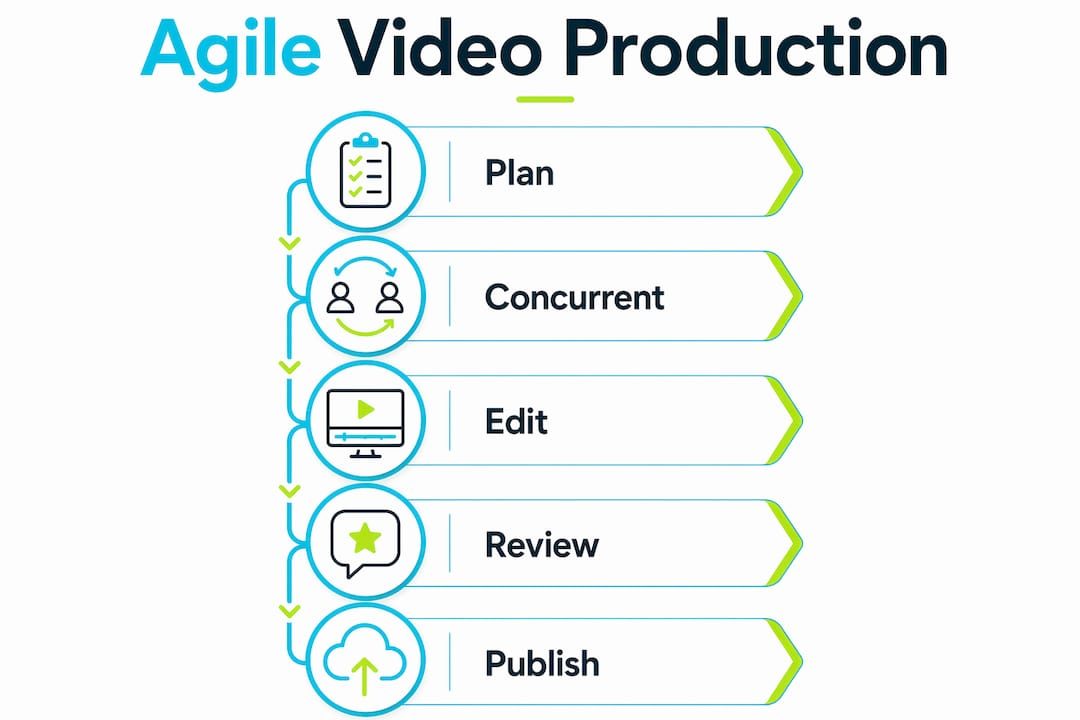
Agile video production solves this by running phases concurrently. While a director finalizes a scene, an editor begins assembling a rough cut. While a client reviews a draft, the motion graphics team prepares alternate versions. This parallel structure compresses timelines and keeps every team member productive throughout the project.
What key challenges does agile video production solve?
Traditional video workflows create predictable failure points. Understanding them helps you see exactly where agile methods deliver the most value.
The core problems with sequential production:
- Budget leakage from handoff delays. 14% to 18% of production budgets disappear in mid-market firms due to inefficient linear workflows. This is not a marginal inefficiency. It is a structural cost built into the traditional model.
- Slow revision cycles. When feedback only arrives at the end of a production phase, a single round of client revisions can add days or weeks to a timeline. Agile workflows build feedback into every sprint, so changes are smaller and faster to implement.
- Creative inconsistency across formats. Over 72% of media executives identify creative consistency across formats as a primary barrier to scaling multi-platform campaigns. Without modular asset systems, each format variation becomes a separate production effort.
- Manual bottlenecks in post-production. Tasks like quality control, transcoding, subtitle generation, and multi-platform formatting are often handled manually, creating queues that slow every project behind them.
- Disconnected remote teams. As production teams become more distributed, the absence of real-time operational visibility creates coordination failures that compound all of the problems above.
Pro Tip: Before restructuring your workflow, map every handoff point in your current production process and note the average wait time at each one. Those wait times are your biggest opportunity for agile improvement.
Agile video production techniques address each of these failure points directly. Concurrent workflows eliminate handoff delays. Continuous feedback loops shrink revision cycles. Modular asset systems solve the format consistency problem. And automation handles the manual post-production tasks that create queues.
How do agile principles apply to the video production process?
The agile video production process adapts four core principles from software development: iterative cycles, continuous collaboration, modular deliverables, and working output over documentation. Here is how each one translates to a production environment.
Typical agile video production phases:
- Discovery sprint. Define the video’s purpose, audience, format requirements, and success metrics before any creative work begins. This replaces the traditional brief-and-wait model with a collaborative kickoff that includes all stakeholders.
- Concept and script iteration. Develop multiple short script or storyboard concepts and review them with the client in a structured session. Select the strongest direction and refine it in a second pass before production begins.
- Modular production. Shoot or generate assets in modular units that can be recombined for different formats, lengths, and platforms. A single shoot day can produce assets for a 90-second brand video, a 30-second social cut, and a 15-second paid ad.
- Parallel post-production. Begin editing, color grading, and motion graphics work while additional footage is still being captured or generated. AI tools handle transcription, subtitle generation, and format conversion automatically.
- Staged review and approval. Share rough cuts with stakeholders at defined intervals rather than waiting for a final cut. Each review session produces a short list of prioritized changes, not an open-ended feedback document.
- Multi-format delivery and performance review. Distribute finished assets and track performance data. Feed results back into the next production sprint to inform creative decisions.
Traditional video production is designed around scarcity of time and labor, while agile AI-enabled pipelines operate on an abundance model, enabling higher output without linear cost increases. This shift in mindset is as important as any specific technique. When you stop treating each video as a one-time production event and start treating it as one iteration in an ongoing content program, your entire approach to planning, budgeting, and team structure changes.
Pro Tip: Build your asset library with reuse in mind from day one. Tag every clip, graphic, and audio file with metadata describing its format, tone, and use case. This turns your archive into a production resource rather than a storage folder.
What role does AI and automation play in agile video content creation?
AI is not a replacement for creative judgment in agile video production. It is the engine that makes iteration fast enough to be practical. Without AI, running five creative variations of a campaign video would require five times the production budget. With AI-assisted workflows, it requires a fraction of that.
AI-assisted workflows reduce time to first draft from 5 to 10 business days down to the same day or within hours, enabling rapid iteration cycles. That compression changes what is possible in a campaign timeline. A marketing team that previously had one chance to get a video right now has the capacity to test, learn, and refine before committing to final distribution.
Multimodal systems like Gemini Omni Flash enable simultaneous video, audio, and graphic generation, transforming real-time production workflows. Tools like Higgsfield handle style consistency across format variations, so a brand’s visual identity holds whether the asset is a 60-second LinkedIn video or a 6-second pre-roll ad.
The most advanced agile production teams build custom plugins in editing software to orchestrate multi-agent background AI pipelines for tasks like scene analysis, localization, and compliance checks. This keeps creative control with the human team while automating the repetitive technical work that slows production.
| Metric | Traditional production | AI-assisted agile production |
|---|---|---|
| Time to first draft | 5 to 10 business days | Same day or within hours |
| Campaign asset delivery | 2 to 3 weeks | 2 to 3 days |
| Monthly video output | 3 to 5 videos | 20 to 30 videos |
| Format variations per asset | 1 to 2 | 5 to 10 |
| Revision turnaround | 2 to 5 days | Hours |
Fast-growing brands using AI video pipelines produce campaign assets in 2 to 3 days versus 2 to 3 weeks with traditional production. That is not a marginal improvement. It is the difference between reacting to a market moment and missing it entirely.
The hybrid human and AI production model keeps core narrative and creative control with humans while AI handles production tasks, avoiding the uncanny valley effects that make fully automated content feel hollow. The creative team defines the story, the tone, and the message. AI executes the technical production work at scale.
Pro Tip: Use AI for high-volume, low-risk content like product explainers, social cuts, and localized versions. Reserve your human production hours for high-stakes brand storytelling where authenticity and emotional nuance matter most.
How to implement agile video production in your team
Adopting agile video content creation requires changes to workflow structure, team roles, and technology. Here is where to focus your effort.
Restructure your workflow for concurrency. Map your current production process and identify every sequential dependency. Ask whether each dependency is genuinely necessary or simply a habit. Most teams find that 40% to 60% of their sequential steps can run in parallel with the right communication structure in place.
Integrate AI tools into your existing editing environment. You do not need to replace your current editing software. Tools like Adobe Premiere Pro, DaVinci Resolve, and Final Cut Pro all support plugin architectures that allow AI agents to handle background tasks. Start with subtitle generation and format conversion before moving to more complex automation.
Build metadata-driven asset pipelines. Companies implementing unified metadata and semantic content structures experience a 30% reduction in time-to-market for new content assets. Tag every asset at ingest with format, tone, campaign, and usage rights data. This makes repurposing and versioning dramatically faster.
Establish real-time visibility for distributed teams. Remote and decentralized production teams need shared dashboards that show project status, asset availability, and review queues in real time. Project management platforms like Frame.io, Asana, or Monday.com integrate directly with video production workflows and give every team member the context they need without requiring status meetings.
Common pitfalls to avoid during adoption:
- Trying to run agile sprints without defined review checkpoints, which recreates the same feedback delays as the traditional model
- Adopting AI tools without training the team on how to direct and quality-check AI output
- Skipping the metadata tagging step because it feels slow at first, then losing hours searching for assets later
- Treating agile as a project management method only, without restructuring the actual production workflow
- Failing to align client expectations with the iterative review model, which leads to scope creep at every sprint
AI video generation lowers barriers and speeds creation of short, practical videos for business communication and marketing, making the technology accessible even to teams without dedicated in-house production staff. You do not need a large team to start. You need a clear workflow and the right tools.
For teams managing remote video production across distributed contributors, real-time visibility and modular asset systems are the two highest-leverage investments you can make in your agile transition.
Key takeaways
Agile video production works because it replaces sequential handoffs with concurrent workflows, continuous feedback, and AI-assisted automation, cutting production timelines from weeks to days while scaling output without proportional cost increases.
| Point | Details |
|---|---|
| Core definition | Agile video production applies iterative sprint cycles and concurrent workflows to replace slow, linear production handoffs. |
| Budget impact | Linear handoffs cost mid-market firms 14% to 18% of annual production budgets, making agile adoption a direct financial decision. |
| AI acceleration | AI-assisted workflows compress first draft delivery from 5 to 10 days down to hours, enabling same-day iteration. |
| Metadata investment | Unified metadata structures reduce time-to-market for new content assets by 30%, making tagging a high-return practice. |
| Human and AI balance | AI handles high-volume technical production tasks while human teams retain creative control over brand narrative and tone. |
Why agile video production is reshaping how I think about content at scale
After 18 years in B2B video production at Kickervideo, I have watched the industry cycle through several “transformative” shifts. Most of them changed the tools without changing the underlying workflow logic. Agile video production is different, and I say that with the skepticism of someone who has seen a lot of trends come and go.
What convinces me is not the AI technology itself. It is the shift from one big creative bet to multiple smaller tests that let brands react faster and optimize based on real audience data. That is a fundamentally different relationship with content. Instead of spending three weeks producing a video and hoping it performs, you produce a draft in a day, test it, learn from it, and improve the next version.
The teams I see struggling with agile adoption are almost always trying to layer agile methods onto a traditional workflow structure. They add sprint planning meetings but keep the sequential handoffs. They buy AI tools but skip the metadata infrastructure. Agile video production is not a feature you add. It is a workflow you rebuild.
The ROI case is clear when you look at the numbers. The creative case is equally strong when you see what teams produce when they are freed from the bottlenecks that used to consume half their time. The role of the video producer does not shrink under agile methods. It shifts toward creative direction, quality control, and strategic planning. That is a better use of skilled people.
— Kicker
How Kickervideo helps marketing teams build agile video workflows
Kickervideo has spent 18 years building B2B video production workflows that deliver results under real marketing constraints. We work with marketing and production teams that need to scale output, maintain brand consistency, and hit campaign deadlines without expanding headcount.
Our production process integrates AI-assisted drafting, modular asset creation, and structured review cycles into a workflow designed specifically for B2B marketing teams. Whether you are producing a series of product explainers, a campaign with multiple format variations, or a library of sales enablement videos, we build the process around your team’s capacity and your audience’s expectations. Explore our B2B video production workflow to see how we structure agile production for marketing teams at every stage of content maturity.
FAQ
What is agile video production in simple terms?
Agile video production is a method that applies iterative sprint cycles and continuous feedback to video content creation, replacing slow sequential workflows with faster, more flexible processes. The goal is to deliver finished video assets sooner while maintaining quality and creative consistency.
How does agile video production differ from traditional production?
Traditional production runs in sequential phases where each stage must complete before the next begins, creating delays and budget leakage. Agile production runs phases concurrently with regular review checkpoints, compressing timelines from weeks to days.
What AI tools are used in agile video production?
Tools like Higgsfield handle style consistency across format variations, while multimodal systems like Gemini Omni Flash generate video, audio, and graphics simultaneously. Editing platforms like Adobe Premiere Pro and DaVinci Resolve support AI plugin integrations for background automation tasks.
How much faster is agile video production compared to traditional methods?
AI-assisted agile pipelines produce campaign assets in 2 to 3 days versus 2 to 3 weeks with traditional production, and can scale output from 3 videos per month to 30 without tripling headcount or budget.
Where should a marketing team start when adopting agile video production?
Start by mapping every handoff point in your current workflow and identifying which sequential steps can run in parallel. Then build a metadata tagging system for your asset library before adding any AI tools, since structured assets are what make automation and repurposing practical at scale.