Why Brand Films Matter for Marketers and Strategists
August 28, 2026 · Video Production Company

Brand films are long-form, narrative-driven video productions designed to create emotional connections between a brand and its audience, rather than sell a product feature. They represent the clearest expression of what a brand believes, not just what it sells. For brand strategists and marketers, understanding why brand films matter is the difference between campaigns that generate clicks and content that builds lasting loyalty. The evidence is direct: 55% of consumers are more likely to purchase from brands whose stories they relate to, and emotionally connected customers are 52% more valuable than merely satisfied ones.
Why brand films matter for emotional connection and loyalty
Brand films work because of how the human brain processes narrative. Stories activate multiple brain regions simultaneously, including sensory, motor, and emotional centers, while a feature list engages only language processing. This neurological difference explains why stories are 22 times more memorable than facts alone. For a brand strategist, that gap is not a creative preference. It is a measurable competitive advantage.

The neuroscience goes further. Narrative triggers oxytocin release, the neurochemical associated with trust and empathy. When a viewer watches a Nike film about an athlete overcoming injury, or a Patagonia documentary about environmental activism, they are not just watching content. They are forming a trust bond with the brand. That bond translates directly into behavior.
The business case is equally strong. Brands using strategic storytelling see 30% higher customer retention and 23% greater revenue growth than competitors relying on feature-driven marketing. Emotionally engaged consumers are 2.4 times more likely to remain loyal and make repeat purchases. These are not marginal improvements. They represent a fundamental shift in customer lifetime value.
Consider what Dove’s “Real Beauty Sketches” film accomplished. It activated an internal hero’s journey from self-doubt to self-compassion, generating millions of organic views and passionate brand advocacy that no paid media budget could replicate. The film did not mention product features. It told a human story, and the brand became inseparable from that story.
“Brand films flip the advertising model, letting consumers opt-in to human-interest stories instead of forcing messages they skip.” — Marketing Dive
What storytelling elements make brand films effective?
The most effective brand films share a specific narrative architecture. Understanding that structure is what separates a film that moves people from one that simply looks expensive.
-
Position the customer as the hero. The StoryBrand framework is explicit on this point: the brand is the guide, not the protagonist. When a brand places itself at the center of the story, audiences disengage. When the customer’s transformation is the focus, audiences see themselves in the narrative.
-
Build genuine tension. Effective brand films introduce a real problem or conflict. Without tension, there is no story. Nike films work because they show the struggle before the triumph. The tension is what keeps viewers watching.
-
Create a clear turning point. The moment of transformation must be visible and earned. It cannot be implied or rushed. Audiences need to feel the shift, not just see it stated.
-
Show transformation, not just resolution. The character at the end of the film must be meaningfully different from the character at the beginning. This is what creates emotional resonance and memory encoding.
-
Apply the removed logo test. A true brand film should be watchable and engaging even without its brand logo. If removing the logo makes the film feel pointless, it is a long ad, not a brand film. This test is the fastest way to evaluate whether your creative team has built a genuine narrative or a product pitch in disguise.
Pro Tip: Before approving a brand film script, remove every mention of your brand name and product. If the story still holds emotional weight, you have a real film. If it collapses, the brief needs to go back to the creative team.
The modular editing approach is equally critical. A single cut rarely performs well across every platform. A three-minute hero film needs to be re-edited into platform-specific versions that respect how audiences behave on Instagram, LinkedIn, or YouTube. Treating each platform as a unique context, not just a distribution channel, is what separates effective brand film strategies from wasted production budgets.
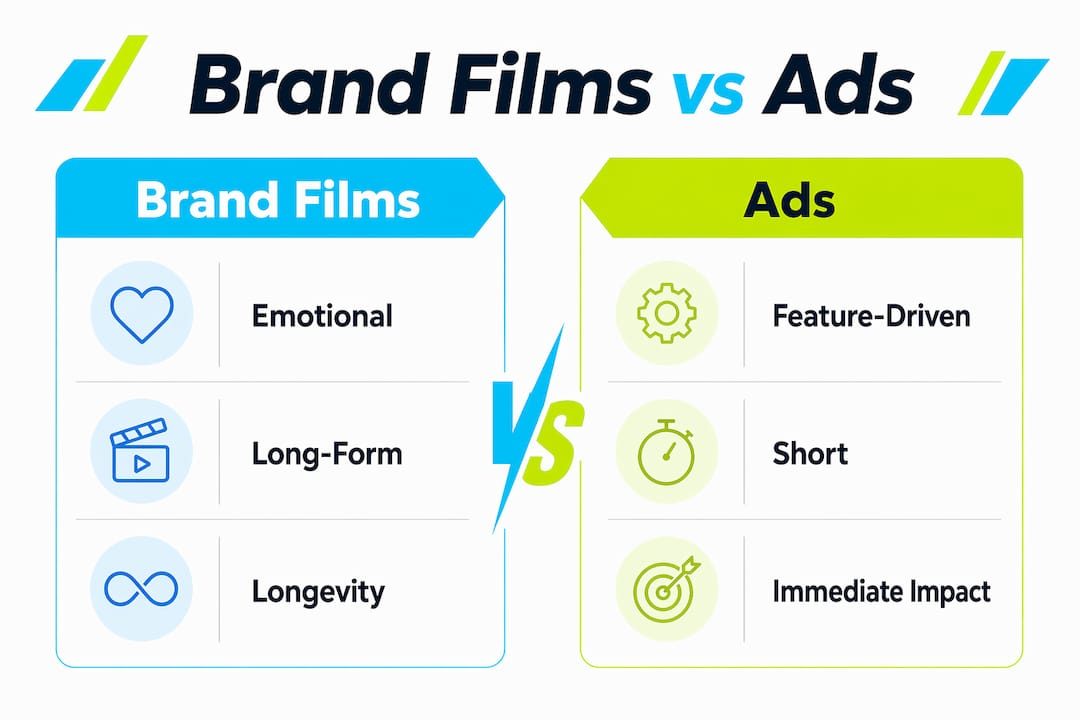
How do brand films differ from other branded video content?
Brand strategists often conflate brand films with other video formats. The distinctions matter because each format serves a different function in the marketing mix.
| Format | Primary purpose | Typical length | Lifespan |
|---|---|---|---|
| Brand film | Emotional connection and brand identity | 2 to 10 minutes | 12 to 18 months |
| Short-form ad | Direct response and product awareness | 15 to 60 seconds | 4 to 8 weeks |
| Testimonial video | Social proof and trust building | 1 to 3 minutes | 6 to 12 months |
| Corporate video | Internal communication or investor relations | 2 to 5 minutes | 12 months |
Brand films function as anchor assets lasting 12 to 18 months, providing long-term brand equity that short-form ads cannot deliver. A direct-response brief applied to a brand film undermines the emotional storytelling architecture the format requires. This is one of the most common and costly mistakes marketing teams make.
Short-form ads are built for conversion at a specific moment. Brand films are built to shift perception over time. Testimonial videos provide authenticity and social proof but lack the narrative depth to create the kind of emotional connection that drives advocacy. Corporate videos serve internal or investor audiences and rarely translate to consumer engagement.
The unique value of brand films lies in their ability to generate earned media and build community. When E.l.f. Cosmetics invested in branded film content, the campaigns extended well beyond paid placements because audiences chose to share them. That opt-in behavior is what distinguishes brand films from every other video format in the marketing toolkit.
How to maximize the impact of brand films in your marketing strategy
Producing a brand film is an investment. Getting the most from that investment requires deliberate planning before, during, and after production.
-
Start with an emotional brief, not a product brief. Define the human truth your brand film will explore. What does your audience struggle with? What transformation do you want them to experience? The answer to those questions is your brief, not a list of product benefits.
-
Plan for modular distribution from day one. Modular editing strategies improve overall engagement across social, email, and website environments. Shoot with platform-specific cuts in mind. A 30-second Instagram version, a 90-second LinkedIn version, and a full-length YouTube version should all be planned during pre-production, not as afterthoughts in the edit suite.
-
Time releases around cultural moments. A brand film about resilience lands differently during a period of public uncertainty than during a period of optimism. Cultural timing amplifies emotional resonance without requiring additional production spend.
-
Extend the film with supplementary content. Transmedia storytelling treats each platform as a unique narrative chapter. Behind-the-scenes content, podcast conversations with film subjects, and social media extensions deepen engagement and allow audiences to participate at multiple levels.
-
Measure what actually matters. Engagement rate, brand recall, and sentiment shift are the right metrics for brand films. Click-through rate and cost-per-acquisition are the wrong ones. Applying direct-response measurement to brand film content will always make the investment look underperforming, because it is measuring the wrong outcomes.
Pro Tip: Set up a brand sentiment survey before your film launches and repeat it 90 days after. The shift in perception data is the most compelling ROI evidence you can bring to leadership when justifying the next brand film investment.
For B2B marketers specifically, video storytelling techniques designed for professional audiences require a different calibration than consumer campaigns, but the emotional principles remain identical. Decision-makers are still human beings who respond to narrative.
Key takeaways
Brand films build measurable competitive advantage by creating emotional connections that feature-driven ads cannot replicate, driving higher retention, greater revenue growth, and lasting brand loyalty.
| Point | Details |
|---|---|
| Emotional connection drives value | Emotionally connected customers are 52% more valuable and 2.4x more likely to stay loyal. |
| Narrative architecture is non-negotiable | Position the customer as hero, build real tension, and show genuine transformation. |
| Brand films are anchor assets | Plan for a 12 to 18 month lifespan and modular distribution across platforms from day one. |
| The removed logo test matters | If your film only works with your logo on it, you have made a long ad, not a brand film. |
| Measure sentiment, not clicks | Brand recall and sentiment shift are the correct success metrics for brand film investment. |
What 18 years of brand film production taught me
Most brands come to us at Kickervideo wanting a brand film because they have seen a competitor produce one that performed well. That is a reasonable starting point, but it is also where most projects go wrong. They want the format without committing to the philosophy behind it.
The brands that get the most from their brand films are the ones willing to tell a story that makes them slightly uncomfortable. Not because discomfort is a creative virtue, but because real stories have real stakes. The moment a brand sanitizes the tension out of its narrative to protect its image, it loses the audience.
I have also seen the trust deficit play out in real time. Only 49% of consumers trust businesses to do the right thing, according to the 2026 Edelman Trust Barometer. That number should alarm every brand strategist in the room. Brand films are one of the few formats that can genuinely move that needle, because they communicate mission and values through story rather than assertion. Telling someone you are trustworthy is far less convincing than showing them who you are.
The other mistake I see consistently is treating a brand film as a one-time campaign. Long-term commitment to a consistent brand story compounds brand equity over time. Brands that produce one film, see moderate results, and move on to the next trend are not building anything. They are spending without accumulating. The brands that win with film are the ones that treat storytelling as a permanent part of their identity, not a quarterly tactic.
If you are a brand strategist reading this, the question is not whether your brand should invest in film. The question is whether you are ready to tell a story worth watching.
— Kicker
How professional video production supports brand film success
Producing a brand film that actually moves audiences requires more than a camera crew and a script. It requires a production partner who understands narrative architecture, platform behavior, and the specific demands of B2B brand communication.
At Kickervideo, we have spent 18 years helping marketing teams produce brand films that perform beyond the launch window. Our B2B video production workflow is built specifically for marketing teams who need modular, platform-ready assets without the chaos of managing multiple vendors. If you are ready to understand the full strategic value of video investment for your brand, we can walk you through exactly what that looks like for your organization. Explore our work and see how we approach brand storytelling for B2B audiences.
FAQ
What is a brand film?
A brand film is a long-form, narrative-driven video that communicates a brand’s values and identity through storytelling rather than product promotion. Unlike short-form ads, brand films are designed to create emotional connection and shift audience perception over time.
How do brand films engage customers differently than ads?
Brand films allow consumers to opt-in to stories that spark curiosity and human interest, while traditional ads are typically skipped within seconds. The narrative format activates emotional and memory centers in the brain, making the brand experience far more memorable.
How long should a brand film be?
Most brand films run between two and ten minutes, with a planned lifespan of 12 to 18 months as anchor assets. Modular edits of 30 to 90 seconds are produced alongside the hero film for platform-specific distribution.
How do you measure the success of a brand film?
The right metrics for brand film effectiveness are engagement rate, brand recall, and sentiment shift, not click-through rate or cost-per-acquisition. Setting up a brand sentiment survey before and 90 days after launch provides the clearest picture of impact.
Why do brand films build more loyalty than standard video ads?
Brands using strategic storytelling see 30% higher customer retention and 23% greater revenue growth than competitors using feature-driven marketing. Narrative activates oxytocin release, which builds trust and drives repeat purchase behavior at a neurological level.