Engaging Leadership Video Topics for Managers in 2026
August 25, 2026 · Video Production Company
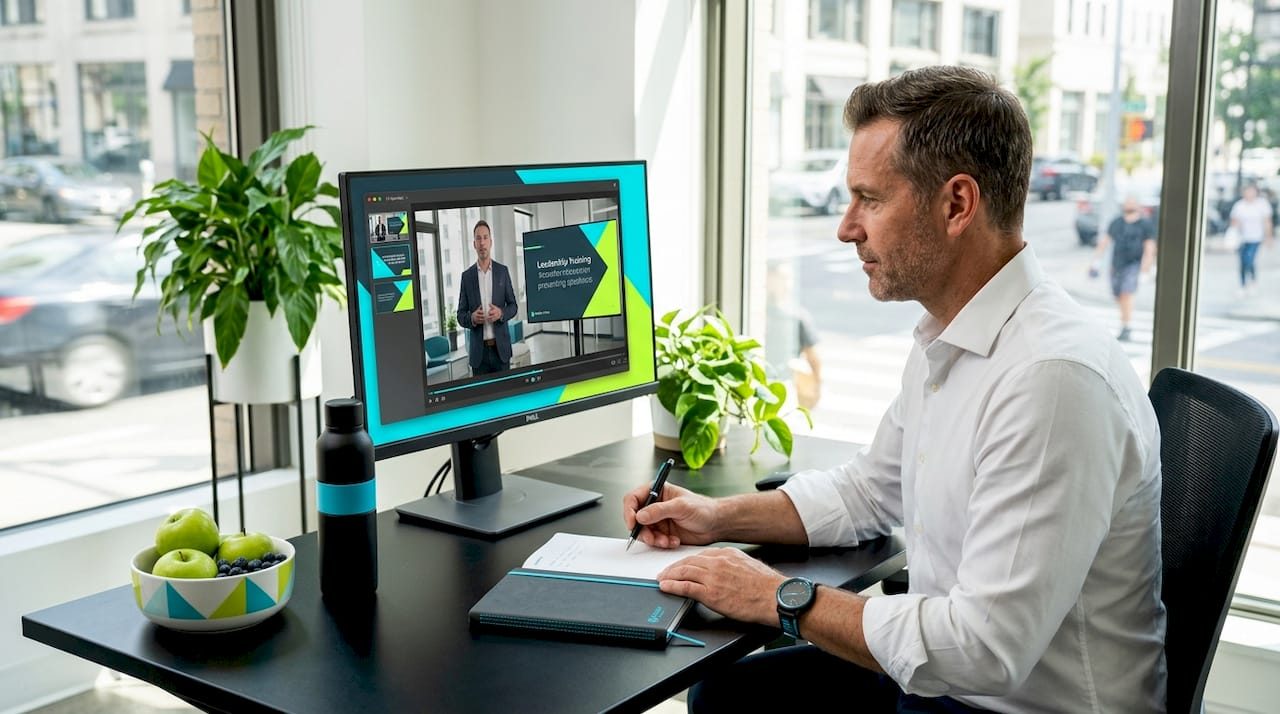
Engaging leadership video topics are short, scenario-driven, and built around skills managers can apply the moment they close the browser tab. The best leadership training video ideas do not teach theory in 45-minute modules. They deliver one behavior, one conversation technique, or one mindset shift in under seven minutes, so your team actually uses what they learn. Platforms like Traliant, Docebo, and MIT Sloan have shaped current best practices around this principle, and the results are clear: focused video content drives higher retention, stronger motivation, and measurable improvement in team communication.
1. What are the most engaging leadership video topics for managers?

The most effective video topics for leadership discussions address the moments managers dread most: the difficult conversation, the underperformer, the team member who shuts down in meetings. These are the situations where a two-minute video watched before a 1:1 meeting can change the entire outcome.
Here are the top topics that consistently resonate with managers:
- Psychological safety in practice. Psychological safety involves specific behaviors that allow team members to speak up without fear, directly impacting innovation and performance. A video on this topic should show a manager responding calmly when someone admits a mistake, not just define the concept.
- Giving actionable feedback. Scripts matter here. A video that walks through a real feedback conversation, word for word, gives managers a template they can adapt immediately.
- Handling difficult conversations. Topics like addressing chronic lateness, performance gaps, or interpersonal conflict are high-stakes and high-frequency. Scenario-based videos that model respectful, direct dialogue are far more useful than abstract frameworks.
- Empathy with boundaries. Managers often confuse empathy with unlimited availability. A video that shows how to acknowledge an employee’s situation while still holding a deadline is a skill most managers have never been explicitly taught.
- Delegation with clarity. Vague delegation creates confusion and resentment. Videos that define ownership, set checkpoints, and model accountability conversations give managers a repeatable process.
- Empowerment over control. Building empowerment through question-based leadership, rather than directive control, builds trust and team ownership. This is one of the most counterintuitive and memorable topics you can put on screen.
Pro Tip: Record a short “before and after” scenario for each topic. Show the manager handling the situation poorly, then handling it well. This contrast format is one of the most effective ways to make the lesson stick.
2. How microlearning video length affects leadership training effectiveness
Training videos work best when kept short: roughly 3 to 7 minutes for general topics, and 1 to 3 minutes for microlearning focused on specific leadership behaviors. This is not a preference. It reflects how attention and task relevance interact in professional learning environments.
| Video type | Ideal length | Best use case |
|---|---|---|
| Microlearning reel | 1 to 3 minutes | Pre-meeting prep, just-in-time skill reinforcement |
| Standard training video | 3 to 7 minutes | Foundational concepts, onboarding modules |
| Modular series | 5 to 10 minutes per episode | Deep skill building over time |
Traliant’s Leadership Micro Reels are under 2 minutes and designed specifically for in-the-moment reinforcement before 1:1s, tough conversations, and leadership huddles. That design choice is intentional. A manager who watches a two-minute video on giving feedback right before a performance conversation is far more likely to apply what they saw than one who completed a 40-minute module three weeks ago.
Splitting longer soft-skills content into manageable microlearning units also prevents training fatigue and encourages repeated viewing. When a video is short enough to rewatch, managers return to it. That repetition is where real skill development happens.
Sequencing matters too. Rather than releasing one long module, structure your content as a series. A five-part series on feedback, each video covering one step of the process, builds skill progressively and keeps managers engaged week over week.
Pro Tip: Design each video to answer one question a manager would actually ask before a real situation. “How do I start a conversation about missed deadlines?” is a better organizing question than “Feedback best practices.”
3. Leadership video themes that matter in an AI-driven workplace
Human leadership traits must be central themes in training content, precisely because AI cannot replicate them. MIT Sloan’s research makes this explicit: purpose, presence, authentic judgment, and personal voice are the qualities that define effective leadership in 2026, and none of them can be automated.
Your video topics should reflect this reality. The most valuable content you can produce focuses on what only a human leader can do:
- Purpose-driven leadership. Videos that help managers articulate why their team’s work matters, not just what the deliverables are, build intrinsic motivation that no productivity tool can generate.
- Presence and attention. A video modeling what it looks like to be fully present in a conversation, phone down, eye contact maintained, follow-up questions asked, teaches a skill that is increasingly rare and increasingly valued.
- Authentic judgment. Scenarios that show a manager making a nuanced call, weighing competing priorities without a clear right answer, build the kind of decision-making confidence that AI-generated recommendations cannot replace.
- Personal voice. Managers who communicate with a consistent, genuine tone build trust faster than those who rely on corporate templates. A video that helps managers find and use their own voice is one of the most human-centric leadership topics you can cover.
Avoiding overreliance on AI-driven productivity tools is itself a worthy video topic. Managers need to understand when to use data and when to trust their read of a room. That judgment is a teachable skill, and video is an excellent format for modeling it.
4. How scenario-based videos improve team communication and motivation
Scenario-driven leadership videos model behaviors rather than describe them, which is why they outperform lecture-style content for communication and motivation training. When a manager watches a realistic coaching conversation unfold on screen, they are not just learning a concept. They are observing body language, tone, pacing, and word choice simultaneously.
Consider these scenario formats that work particularly well:
- GROW model coaching session. A manager walks an employee through Goal, Reality, Options, and Will in a real conversation. Watching this live makes the model concrete and repeatable.
- Responding to a microaggression. A video that shows a manager addressing a subtle exclusionary comment in a team meeting, calmly and directly, gives leaders a script for one of the most uncomfortable situations they face.
- Conflict resolution between two team members. A manager mediates a disagreement without taking sides. This scenario teaches neutrality, active listening, and structured problem-solving in one scene.
- Motivation conversation with a disengaged employee. The manager asks questions rather than delivers a pep talk. This models the empowerment approach that builds ownership and trust.
“The most effective leadership videos show the conversation, not just the concept. Managers learn by watching someone else do it first.”
Videos that engage multiple senses, including dialogue, visual cues, and realistic workplace settings, make skills more memorable. The goal is for a manager to recognize a situation in real life and recall exactly what they saw on screen.
5. Comparison of video formats to maximize leadership impact
Choosing the right format for your effective leadership video content depends on what you need managers to do with the information and when they need to use it.
| Format | Retention strength | Practical use | Time required |
|---|---|---|---|
| Microlearning reel | High for single behaviors | Just-in-time, pre-meeting | 1 to 3 minutes |
| Modular video series | High for foundational skills | Onboarding, structured programs | 5 to 10 minutes per module |
| Scenario-based role play | Highest for applied skills | Skill practice, refreshers | 3 to 7 minutes |
Combining video formats maximizes leadership development impact. Use microlearning reels for just-in-time application and longer modular content for foundational knowledge. This is not an either-or decision.
For onboarding, start with modular videos that build a shared leadership framework across your team. For ongoing development, use microlearning reels tied to recurring leadership moments. For refreshers before performance reviews or team resets, scenario-based videos give managers a behavioral model to draw from. You can explore corporate training video formats in more detail to match each format to your specific program goals.
The managers who get the most from video training are those whose organizations treat it as a continuous resource, not a one-time event. Short, focused videos that are easy to revisit are the foundation of that approach. Understanding why video works for employee training helps you build a program that managers actually return to.
Key takeaways
The most effective leadership video topics combine microlearning formats with scenario-based content, focusing on human skills that managers can apply immediately in real workplace situations.
| Point | Details |
|---|---|
| Keep videos short and focused | Use 1 to 3 minutes for microlearning and 3 to 7 minutes for broader topics to maintain attention. |
| Prioritize scenario-based content | Show real conversations and behaviors on screen rather than explaining abstract frameworks. |
| Focus on human-only leadership skills | Topics like psychological safety, empathy, and authentic judgment cannot be replicated by AI tools. |
| Sequence content for skill building | Release videos as a series tied to recurring leadership moments rather than as a single long module. |
| Mix formats for maximum impact | Combine microlearning reels with modular and scenario-based videos to support both foundational and just-in-time learning. |
What 18 years of production work has taught me about leadership videos
After working with B2B teams for nearly two decades at Kickervideo, the pattern I see most often is this: organizations spend significant time deciding what to teach and almost no time deciding how to show it. The topic list is solid. The format is an afterthought. That is where most leadership video programs lose their impact.
The managers I have seen grow the most from video training are not the ones who completed the longest courses. They are the ones who watched a two-minute video right before a hard conversation and had a clear model in their head when they walked into the room. That is the power of format alignment. The right topic delivered at the wrong time, in the wrong length, does not land.
I am also convinced that the AI-in-leadership conversation is creating a genuine opportunity for video content. Managers are uncertain about what their role looks like when AI handles more of the analytical work. Videos that answer that question directly, by modeling presence, judgment, and authentic communication, are some of the most valuable content you can produce right now. The teams that build this content in 2026 will have a meaningful advantage in leadership development for years ahead.
— Kicker
How Kickervideo helps you produce leadership videos that actually work
Kickervideo has spent 18 years producing B2B training videos that get used, not just completed. If you are building a leadership video program, the difference between content that changes behavior and content that gets clicked through comes down to production quality, script structure, and scenario design. Our team works with you to develop high-impact leadership videos built around the microlearning and scenario-based formats that research consistently supports. From scripting realistic workplace conversations to producing modular series your managers will return to, Kickervideo handles the production so you can focus on the outcomes. See how professional video production translates directly into stronger leadership development results for your team.
FAQ
What makes a leadership video topic engaging for managers?
Engaging topics address real situations managers face regularly, such as giving feedback, handling conflict, or building psychological safety, and present them through realistic scenarios rather than abstract theory. Videos under seven minutes that focus on one behavior at a time consistently outperform longer, lecture-style content.
How long should leadership training videos be?
Optimal video length is 1 to 3 minutes for microlearning focused on a single behavior, and 3 to 7 minutes for broader leadership topics. Longer videos should be split into a series to maintain attention and encourage repeated viewing.
What leadership topics should focus on human skills rather than AI tools?
Topics like psychological safety, empathy, authentic judgment, and purpose-driven communication are the most valuable because AI cannot replicate these qualities. Videos that model these behaviors give managers skills that remain relevant regardless of how workplace technology evolves.
How does microlearning support just-in-time leadership development?
Traliant’s Leadership Micro Reels are designed to be watched immediately before leadership moments like 1:1 meetings or difficult conversations, closing the gap between learning and doing. This format supports application in real time rather than recall from a training session weeks earlier.
What is the best format for building leadership communication skills on video?
Scenario-based videos that show realistic workplace conversations, including coaching sessions, conflict resolution, and feedback delivery, are the most effective format for communication skill development. Watching a behavior modeled on screen gives managers a concrete reference point they can draw on in their own conversations.