
Visual effects are no longer the exclusive domain of Hollywood blockbusters. If you work in marketing or communications, the explainer for VFX in business you actually need is one that skips the film-school theory and gets straight to what VFX can do for your brand content. The global VFX market sits at USD 14.93 billion in 2026 and is projected to reach USD 26.53 billion by 2032, growing at 8.56% annually. Corporate storytelling is driving a significant share of that growth, and your competitors are already paying attention.
Table of Contents
- Key takeaways
- VFX types used in business marketing
- VFX and brand storytelling strategy
- Emerging trends in VFX production
- Planning and commissioning VFX content
- Measuring the impact of VFX content
- My perspective on VFX for brand marketing
- How Kickervideo helps brands use VFX effectively
- FAQ
Key takeaways
| Point | Details |
|---|---|
| VFX is not just for film | Businesses use VFX for explainer videos, product demos, and brand campaigns at accessible price points. |
| AI changes production speed | Reasoning-native AI tools now maintain narrative continuity across multi-shot sequences, cutting production timelines. |
| Strategy comes before production | Identifying which projects benefit from VFX before commissioning work protects budget and improves results. |
| Metrics must match goals | Track engagement, watch time, and qualitative brand feedback together to assess VFX content fairly. |
| Brief quality determines output | A detailed creative brief aligned to brand goals is the single biggest factor in VFX production success. |
VFX types used in business marketing
Before you can apply VFX strategically, you need to know which types actually show up in corporate content. The term “visual effects” covers a broader set of techniques than most marketers realize.
VFX integrates realistic effects into live footage through compositing and physics simulation, while animation builds sequences entirely from scratch. That distinction matters when you are briefing a production team, because the workflows, timelines, and costs differ considerably.
Here are the VFX types most relevant to business content:
- CGI elements: Digitally created objects, environments, or product renders composited into real footage. Useful for showing product interiors, architectural concepts, or features not visible to the naked eye.
- Compositing: Layering multiple video elements, including graphics, text, and effects, into a single cohesive scene. This is the backbone of most corporate VFX work.
- Motion graphics: Animated text, icons, data visualizations, and branded transitions. These are technically a subset of VFX when layered over live video.
- Green screen and virtual sets: Replacing filmed backgrounds with custom environments, which is common in corporate video productions and executive communications.
- Particle effects and simulations: Fluid, fire, or energy effects that add visual drama to product reveals or brand campaigns.
| VFX type | Best marketing use | Production complexity |
|---|---|---|
| CGI elements | Product demos, explainer videos | Medium to high |
| Compositing | Brand films, testimonial videos | Low to medium |
| Motion graphics | Social content, presentations | Low |
| Green screen | Corporate communications, ads | Low to medium |
| Particle effects | Brand campaigns, product launches | High |
Understanding this table helps you allocate budget more precisely. Motion graphics and compositing give you strong visual impact without the cost of full CGI production.
VFX and brand storytelling strategy
VFX earns its place in marketing when it makes a concept tangible that would otherwise stay abstract. Motion graphics and visual effects help businesses simplify complex concepts and engage audiences using visual storytelling techniques. That is the practical value. A software company explaining a data security architecture does not need actors in a server room. A well-produced composite visual showing data flowing through protected layers communicates the idea faster and more memorably.
The most effective VFX business applications share three characteristics:
- They serve the message, not the other way around. The effect exists because it clarifies or amplifies a point.
- They match the brand’s visual identity. Custom color palettes, typography, and motion styles keep the content coherent.
- They are planned at the scripting stage. VFX added in post-production as an afterthought almost always looks like an afterthought.
AI-generated VFX tools now allow brands to tell aspirational stories using surreal environments impossible to film with traditional equipment. Standard Chartered Hong Kong demonstrated this by reimagining existing footage with generative AI to create surreal travel environments, shortening production cycles significantly. That kind of agility is now available to brand teams beyond the biggest advertisers.
When you measure the marketing impact of VFX-enhanced videos, focus on these indicators:
- Watch-through rate compared to non-VFX content in the same campaign
- Social sharing and save rates, which signal that audiences found the content worth keeping
- Lead quality from campaigns where VFX content was the entry point
Pro Tip: Run A/B tests with VFX and non-VFX versions of the same video concept. Even small sample sizes reveal whether the production investment is moving the right numbers for your specific audience.
Emerging trends in VFX production

The most significant shift in VFX production for businesses right now is not just that AI exists. It is that AI tools have moved from pattern-matching to reasoning. Earlier generative video tools struggled with continuity. Characters changed appearance between shots. Physics behaved inconsistently. Those problems made multi-shot VFX sequences unreliable for professional brand content.
Reasoning-native AI video generation solves continuity and narrative consistency issues found in earlier models, making multi-shot coherent VFX videos achievable at scale. Tools built on this architecture maintain character identity and physical coherence across sequences, which is the minimum requirement for anything representing a brand.
For enterprise marketing teams, the infrastructure around VFX production matters as much as the output quality. Studio-grade AI platforms provide version control, audit trails, and collaborative workflows. Consumer-grade generative tools lack these controls, making them unsuitable for teams managing brand compliance, legal review, and multi-stakeholder approval processes.
Production infrastructure with reasoning-based AI generation fundamentally shifts creative workflows, enabling narrative cohesion across multi-shot VFX sequences. Traditional clip assembly is replaced by description-driven generation with maintained continuity.
Key benefits enterprise teams gain from AI-assisted VFX platforms:
- Faster iteration: Review cycles shorten because generating new versions does not require rebuilding composites manually.
- Budget transparency: Detailed production logs make cost tracking easier across complex campaigns.
- Team collaboration: Multi-role access means your creative director, brand manager, and compliance team can review in the same environment.
- Scalable output: A single concept can generate multiple format variations for different platforms without proportional cost increases.
Pro Tip: When evaluating AI VFX platforms for business use, ask specifically about version control and asset management features. These operational details determine whether the tool works in a real marketing environment or just in a demo.
Planning and commissioning VFX content
The difference between VFX content that performs and VFX content that disappoints almost always comes down to preparation. Effective VFX production requires carefully aligned creative briefs and strong communication between marketers and production teams.
Here is a practical process for planning your VFX video content:
- Identify the right projects. Not every video needs VFX. Prioritize content where a concept cannot be shown adequately with camera work alone. Product demos, process explanations, and aspirational brand films are strong candidates.
- Define your objective before the brief. Is this content for awareness, consideration, or conversion? The answer affects which VFX types are appropriate and how much production complexity is justified.
- Create a detailed script with visual notes. The script should describe not just the dialogue or narration but also what the viewer sees at each moment. VFX teams work from these descriptions, and vague scripts produce vague results.
- Set budget ranges with a contingency. VFX revisions can extend timelines. Plan for at least one round of structural feedback beyond the standard review process.
- Brief to brand standards. Provide your production team with brand guidelines, approved color palettes, typography, and examples of content you want to reference or avoid.
- Establish approval checkpoints. Define who signs off at the concept, rough cut, and final stages. Surprises at final delivery are expensive.
A written checklist for your VFX brief should include: campaign objective, target audience description, tone and style references, mandatory brand elements, platform specifications, and legal or compliance requirements.
Pro Tip: Share competitor VFX content with your production team. Not as a template to copy, but as a benchmark. Production teams deliver stronger concepts when they understand the competitive environment your brand operates in.
Measuring the impact of VFX content
ROI for VFX-enhanced marketing content is measurable, but only if you define your metrics before production starts. Tracking VFX content ROI involves combining engagement metrics, viewership data, and qualitative brand impact feedback.
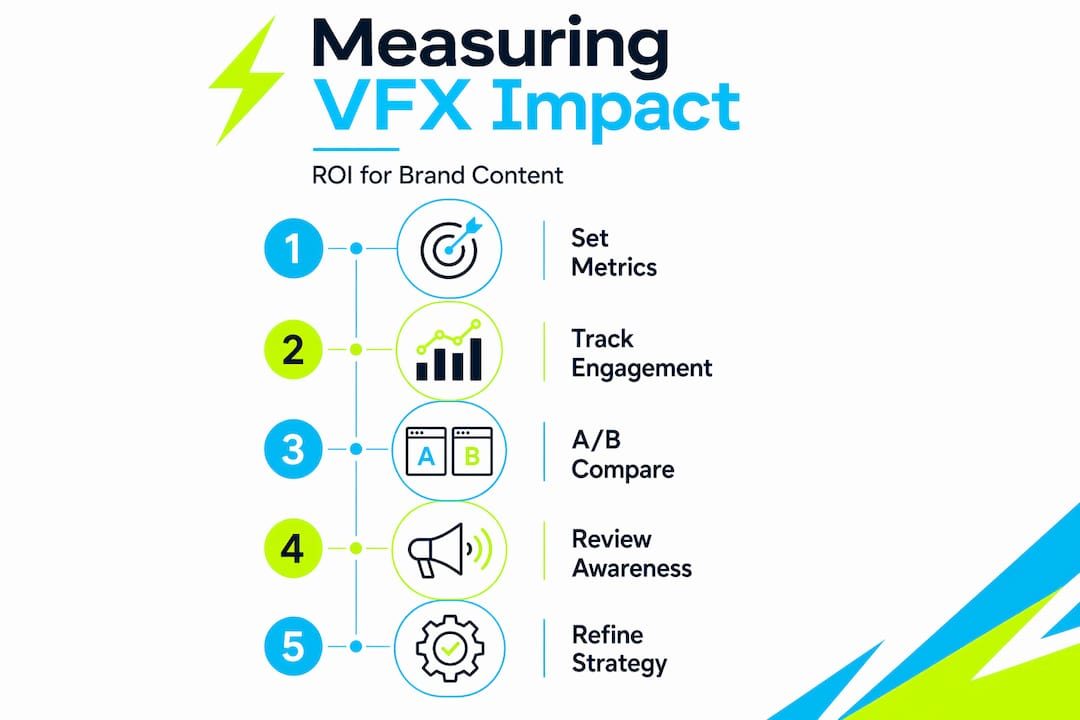
The following table organizes the most useful metrics by campaign goal:
| Campaign goal | Primary metric | Supporting metric |
|---|---|---|
| Brand awareness | Reach and impressions | Unaided brand recall score |
| Audience engagement | Watch-through rate | Shares and saves |
| Lead generation | Click-through rate | Lead quality score |
| Product understanding | Time on page or video | Support ticket volume |
| Conversion | Conversion rate | Cost per acquisition |
A few things to watch for when evaluating results:
- Avoid single-metric attribution. VFX content often builds awareness that converts later through a different channel. Multi-touch attribution gives a more accurate picture.
- Collect qualitative feedback. Ask sales teams what prospects say about your video content. Brand impression data from qualitative sources often reveals impact that click data misses.
- Compare content types. Your VFX video should be benchmarked against other video formats in the same campaign, not against static content, which is a different medium entirely.
- Track content lifespan. Well-produced VFX content often continues generating views and leads long after the initial campaign period. Include long-tail performance in your assessment.
The most common mistake marketers make is evaluating VFX investment on short-term campaign metrics alone. High-quality visual effects in marketing contribute to brand perception over time, and that accumulates in ways a single campaign report will not capture.
My perspective on VFX for brand marketing
I have spent 18 years working with marketing and communications teams on video production, and the conversations around VFX have changed dramatically. For most of that time, VFX was a budget conversation before it was a creative one. Teams wanted the impact but could not justify the cost for anything outside a major campaign.
What I have seen more recently is that the access question has shifted. AI-assisted VFX production has lowered the floor significantly. A mid-size company can now commission motion-graphics-heavy explainer content or even AI-assisted composite brand films at budgets that would have felt unrealistic five years ago. That is genuinely good for brand storytelling.
The challenge I watch teams run into is narrative continuity. The technology moves fast, but the creative fundamentals do not. I have reviewed AI-generated VFX sequences that are visually impressive but tell the story badly because the brief was weak. Reasoning-native tools help, but they do not replace clear thinking about what the video needs to communicate.
My honest advice: treat VFX as a storytelling investment, not a production upgrade. The brands that get the most from visual effects in marketing are the ones that start with a clear message and then ask how VFX serves it. The ones that start with “let’s make it look amazing” almost always spend more and say less.
— Kicker
How Kickervideo helps brands use VFX effectively
At Kickervideo, we have been producing B2B video content for 18 years. We understand that marketing teams need more than technical production skills. They need a partner who understands brand strategy, audience behavior, and how to make visual storytelling work across the full content lifecycle.
Whether you are planning your first VFX-enhanced explainer or building a library of brand content, we can help you get from concept to finished video with less friction and stronger results. Explore our B2B video formats guide to understand which video types fit your current marketing goals. If you want to understand the full production process before commissioning work, our video production overview walks you through every stage. When you are ready to talk about your next project, the Kickervideo team is here to help you plan, produce, and measure content that performs.
FAQ
What is VFX in a business context?
VFX in business refers to the use of visual effects techniques, including compositing, CGI, and motion graphics, to enhance corporate video content such as explainer videos, brand films, and product demos.
How does VFX differ from animation in marketing videos?
VFX integrates digital effects into live footage, while animation creates sequences entirely without camera footage. Many business videos use both, but the technical demands differ significantly.
Is VFX affordable for mid-size businesses?
Yes. Motion graphics and compositing-based VFX are accessible at moderate budgets, and AI-assisted production tools have reduced costs further. The investment level should match the complexity of what you need to communicate.
How do you measure the ROI of VFX video content?
Combine platform engagement metrics like watch-through rate and shares with qualitative feedback and long-term brand awareness data. Avoid attributing results to VFX alone when multiple content types are active in the same campaign.
What makes a good VFX creative brief?
A strong brief includes the campaign objective, audience description, platform specs, tone references, mandatory brand elements, and clear approval checkpoints. Vague briefs are the leading cause of costly revisions in VFX production.