How to Engage Stakeholders for Better Project Outcomes
August 24, 2026 · Video Production Company

Stakeholder engagement is the intentional process of identifying, understanding, and involving everyone affected by your projects to build trust, reduce risk, and drive shared success. Most managers treat it as a communication task. It is not. Frameworks like PMBOK 8, AA1000SES, and GRI 2-29 define it as a living discipline focused on attitude and behavior change, not just information delivery. When you get it right, projects move faster, decisions improve, and resistance drops before it becomes a crisis.
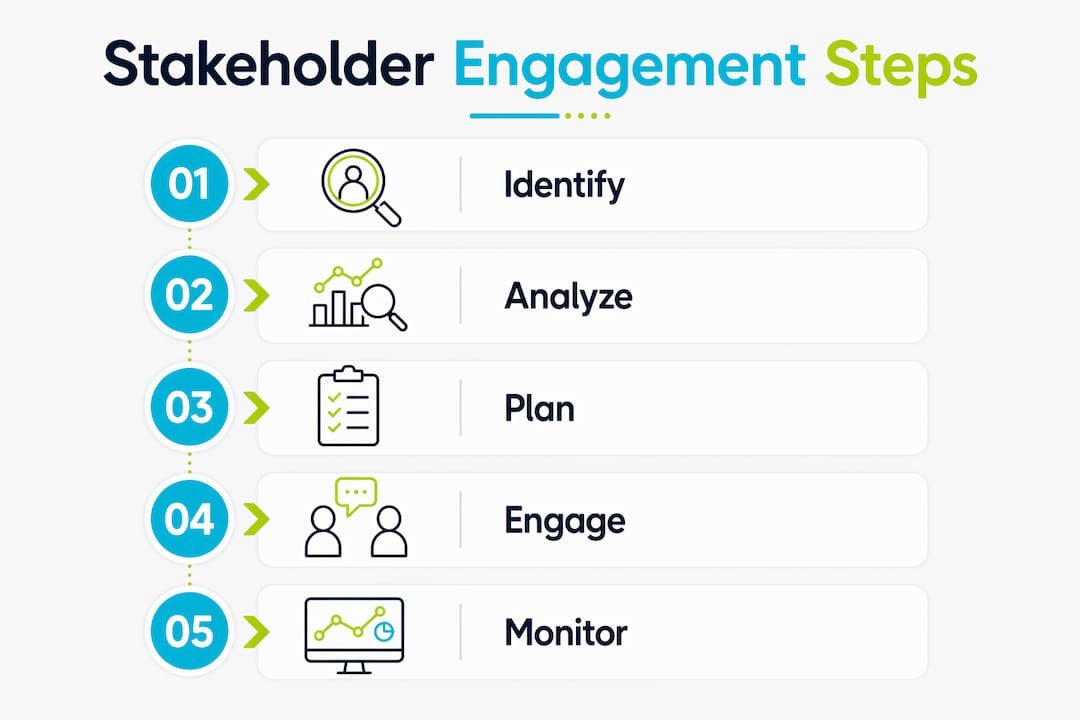
How to engage stakeholders: start with identification and analysis
You cannot build a meaningful engagement plan without first knowing who your stakeholders are, what they care about, and how much influence they hold. Effective engagement starts with mapping influence, motivations, and who matters to decisions early. Skipping this step turns engagement into guesswork.
Building your stakeholder register
A stakeholder register is a structured record of every person, group, or organization with a stake in your project. It should include their role, level of influence, primary interests, and current attitude toward the project. Across industries, stakeholders typically fall into categories like executive sponsors, regulatory bodies, frontline employees, customers, suppliers, and community groups.
The Power/Interest grid is the most practical tool for initial mapping. It places stakeholders on two axes: how much power they hold over your project and how much interest they have in its outcomes. This gives you four groups to manage differently.
| Stakeholder Group | Power | Interest | Engagement Priority |
|---|---|---|---|
| Executive sponsors | High | High | Collaborate closely and frequently |
| Regulatory bodies | High | Low | Keep informed with concise updates |
| End users | Low | High | Consult regularly and gather feedback |
| General public | Low | Low | Monitor and inform as needed |
Beyond the grid, you need to assess the gap between where each stakeholder currently stands and where you need them to be. A regulatory body that is neutral today may need to become supportive before a key approval milestone. Identifying that gap early lets you plan the right intervention before the deadline arrives.
- Map stakeholders by power, interest, and influence before any engagement begins
- Record current engagement levels alongside desired levels for each group
- Identify stakeholders who are unaware of the project entirely, since they carry hidden risk
- Revisit your register at every major project phase, not just at kickoff
- Include internal and external stakeholders, because both groups shape outcomes
Incomplete identification is one of the most common causes of project failure. A supplier left off the register, or a community group overlooked during planning, can surface late with enough influence to delay or derail your work entirely.
Designing tailored engagement strategies for different stakeholder groups
Once you know who your stakeholders are, you need a plan that addresses the gap between where they are and where they need to be. PMBOK 8 frames engagement as a living plan that moves stakeholders through defined levels: Unaware, Resistant, Neutral, Supportive, and Leading. Each level requires a different approach.

The depth of your engagement should match both the stakeholder’s current level and the influence they hold. The International Association for Public Participation (IAP2) spectrum offers a practical model for selecting that depth: inform, consult, involve, collaborate, or empower. A resistant executive sponsor needs a different strategy than a neutral end user.
Here is how to build a tailored engagement plan for each group:
- Identify the current engagement level for each stakeholder using your register data and direct observation.
- Define the desired engagement level based on the role that stakeholder plays in project success.
- Conduct root cause analysis for resistant stakeholders. Resistance usually signals unmet concerns, not opposition to the project itself.
- Select the appropriate depth of engagement. Informing works for low-power, low-interest groups. Collaboration is required for high-power stakeholders whose buy-in shapes decisions.
- Assign channels, frequency, and responsible parties. A high-power resistant stakeholder may need weekly one-on-one conversations. A supportive end user group may need a monthly newsletter and a quarterly workshop.
- Document the plan and review it at defined milestones. Engagement plans that live only in someone’s head do not survive team changes or project pivots.
The AA1000SES standard emphasizes three principles that prevent tokenistic engagement: inclusivity, materiality, and responsiveness. Inclusivity means involving those genuinely affected. Materiality means focusing on issues that actually matter to them. Responsiveness means acting on what you hear and communicating what changed as a result.
Pro Tip: Separate your engagement plan from your communication plan. A communication plan tracks what information goes to whom and when. An engagement plan tracks attitude, behavior, and relationship progress. Conflating the two causes teams to mistake information delivery for genuine involvement.
Best practices for executing and maintaining stakeholder engagement
Designing a plan is the easy part. Executing it consistently over the life of a project requires discipline, emotional intelligence, and structured feedback loops. Closing the feedback loop by showing stakeholders what changed builds credibility and trust. Without it, stakeholders stop contributing because they see no evidence their input matters.
Two-way communication is the defining characteristic of genuine engagement. You are not broadcasting updates. You are creating conditions where stakeholders can raise concerns, ask questions, and influence decisions within appropriate boundaries. That distinction changes how you design every interaction.
- Use multiple feedback channels to maximize participation. Surveys, in-person meetings, and virtual options each reach different stakeholder segments.
- Record every stakeholder input persistently. Persistent records create stakeholder intelligence that compounds over time, so you never restart from zero at the beginning of a new project phase.
- Assign clear ownership for each engagement activity. When no one owns a relationship, it deteriorates.
- Build emotional intelligence into your team’s approach. Stakeholders respond to how they are treated as much as to what they are told.
- Conduct structured workshops for high-stakes decisions. Workshops create shared context and reduce the misalignment that causes costly late-stage changes.
Monitoring engagement should be a continuous process with defined cadences aligned to project milestones. Monthly or quarterly reviews allow early detection of issues and strategy adjustments before problems escalate. A stakeholder who was supportive at kickoff may shift to resistant after a scope change. You need a system that catches that shift early.
Pro Tip: Build a simple stakeholder log that captures every significant interaction, concern raised, and commitment made. Review it before every major meeting. This single habit prevents the most common engagement failure: repeating conversations that already happened and losing credibility with stakeholders who feel unheard.
Common challenges and solutions in stakeholder engagement
Even well-designed engagement plans run into predictable problems. Recognizing them early gives you the opportunity to correct course before they damage trust or project outcomes.
Engaging too late. The most damaging mistake is starting engagement after key decisions are already made. Stakeholders who are consulted on decisions they cannot influence quickly recognize the process as performative. Avoiding performative engagement requires early, sustained, inclusive, and context-tailored involvement from the start of planning.
Treating engagement as communication. Sending updates is not engagement. Engagement requires dialogue, responsiveness, and visible evidence that stakeholder input shapes outcomes. Organizations that confuse the two consistently underperform on trust metrics and project delivery.
Handling conflicting feedback. Different stakeholder groups will often have opposing priorities. A regulatory body may push for slower timelines while an executive sponsor demands speed. The solution is transparent prioritization: explain the trade-offs openly, document the decision rationale, and communicate it to all affected groups.
“Meaningful engagement involves ongoing, respectful dialogue that shapes decisions and aligns with due diligence obligations.” This principle, drawn from practical guidance on engagement in high-risk supply chains, applies equally to any industry where trust and accountability matter.
Ensuring inclusivity. Dominant voices in any stakeholder group can crowd out quieter but equally important perspectives. Structured facilitation, anonymous feedback options, and deliberate outreach to underrepresented groups all help correct this imbalance.
Recovering from failing engagement. If trust has broken down, acknowledge it directly. Stakeholders respect honesty about process failures far more than continued pretense. Reset with a clear statement of what will change, then follow through visibly.
Key takeaways
Effective stakeholder engagement requires tailored strategies based on each stakeholder’s influence, current engagement level, and specific concerns, supported by persistent feedback loops and continuous monitoring.
| Point | Details |
|---|---|
| Start with stakeholder mapping | Use the Power/Interest grid to prioritize engagement depth and frequency for each group. |
| Match engagement depth to need | Apply the inform-to-empower spectrum based on stakeholder influence and current attitude. |
| Separate engagement from communication | Track attitude and behavior change, not just information delivery, to measure real progress. |
| Close the feedback loop | Show stakeholders what changed because of their input to build lasting credibility and trust. |
| Monitor continuously | Review engagement status at defined milestones to catch attitude shifts before they become crises. |
What 18 years of stakeholder work has taught me
Most leaders I have worked with over the years treat stakeholder engagement as a project management formality. They build a register at kickoff, send updates on a schedule, and call it done. The projects that struggle most are almost always the ones where that pattern holds.
What actually works is treating stakeholder engagement as an intelligence function. Every conversation, every piece of feedback, every concern raised is data. When you record it, track it, and act on it visibly, you build something that no communication plan can replicate: genuine trust. And trust is what makes the hard conversations possible when a project hits a difficult phase.
I have also seen how much channel selection matters. Tailoring messaging to channel preferences without diluting the core narrative significantly improves multi-audience engagement. A board update delivered as a two-minute video summary lands differently than a 12-slide deck. A frontline team briefed through a short visual walkthrough retains more than one briefed through a written memo. The content is the same. The format changes everything.
The leaders who build the strongest stakeholder relationships also tend to prioritize high-power resistant stakeholders with more frequent, proactive attention rather than waiting for those stakeholders to escalate. That proactive cadence, grounded in engagement cadence principles from PMBOK 8, is the single habit that most consistently separates successful projects from troubled ones.
— Kicker
How Kickervideo helps you communicate with stakeholders more effectively
Stakeholder engagement depends on clear, credible communication. For business leaders managing complex projects, professional video is one of the most effective tools for delivering updates, building trust, and demonstrating responsiveness to stakeholder concerns.
Kickervideo has spent 18 years producing B2B video content that helps leaders communicate with clarity and confidence. From executive briefing videos to project update formats designed for distributed stakeholder groups, the right video format makes your message land and stay. Whether you need a B2B video production workflow built around your engagement calendar or a single high-stakes stakeholder presentation, Kickervideo builds content that supports real relationships. You can also explore how professional video services create measurable impact across B2B stakeholder communication.
FAQ
What is the difference between stakeholder management and engagement?
Stakeholder management focuses on identifying stakeholders and tracking their influence on a project. Stakeholder engagement goes further by actively building relationships, addressing concerns, and involving stakeholders in decisions to shift their attitudes and behaviors toward project success.
How do you identify the right stakeholders for a project?
Start by mapping everyone with a stake in the project’s outcomes using a Power/Interest grid. Include internal groups like executives and employees alongside external groups like regulators, customers, and suppliers. Revisit the list at each major project phase since stakeholders change as scope evolves.
What are the five engagement levels in PMBOK 8?
PMBOK 8 defines five stakeholder engagement levels: Unaware, Resistant, Neutral, Supportive, and Leading. Each level requires a different engagement strategy, and the goal is to move each stakeholder toward the level needed for project success.
How do you handle resistant stakeholders?
Conduct a root cause analysis to understand what is driving the resistance. Most resistance reflects unmet concerns or insufficient information rather than fundamental opposition. Address those concerns directly, involve the stakeholder in relevant decisions, and close the feedback loop by showing how their input influenced outcomes.
How often should you review your stakeholder engagement plan?
Monthly or quarterly reviews aligned to project milestones are the standard recommended by PMBOK 8. High-stakes projects or those with resistant high-power stakeholders may require more frequent check-ins to catch attitude shifts early.