
Micro content is defined as short, high-value assets consumed in seconds, typically text under 200 words or video under 60 seconds, and it serves as the primary engagement layer for time-constrained B2B decision-makers. The role of micro content in B2B goes far beyond filling a content calendar. It functions as the first point of contact in a buyer journey that may span months, giving your audience a reason to pay attention before they are ready to commit to a webinar, a demo, or a full report. Platforms like LinkedIn, YouTube Shorts, and TikTok have each developed native formats that reward this type of content, making short-form assets a practical necessity for any B2B marketing team operating in 2026.
How micro content acts as a gateway in the B2B buyer journey
Micro content acts as a gateway in B2B by providing quick samples that encourage buyers to engage with longer assets like webinars or reports. Think of it as the first handshake. It lowers the commitment threshold enough that a busy VP of Operations will stop scrolling, absorb a single insight, and click through to something deeper.
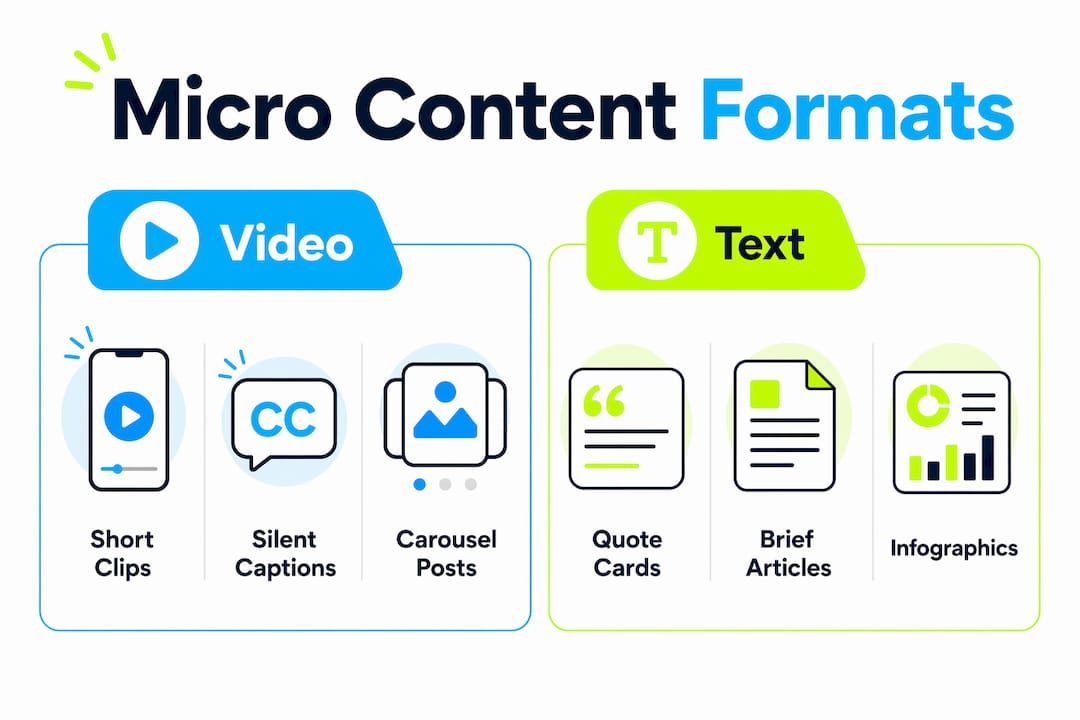
The most effective micro content examples in B2B include LinkedIn posts that distill one bold finding from a research report, short teaser videos that preview a product feature, and quote cards pulled directly from subject matter expert (SME) interviews. Each piece delivers standalone value while pointing toward a larger asset. That combination is what separates high-performing micro content from content that simply takes up space.
- LinkedIn posts that surface one data point from a longer study
- Short teaser videos (under 60 seconds) previewing a webinar or case study
- Quote cards from internal SMEs that build credibility and encourage shares
- Infographic snippets that visualize a single comparison or stat
Pro Tip: Repurpose expert insights from existing webinars or interviews into micro content. You get authoritative voices without scheduling new production time, and your SMEs build personal brand equity in the process.
What micro content formats work best for B2B

Not all formats perform equally across platforms, and matching format to platform is one of the most underrated decisions in a B2B micro content strategy. Video length norms differ by platform: LinkedIn performs best with clips between 45 and 90 seconds, YouTube Shorts caps at 60 seconds, and TikTok favors 15 to 30 seconds. These are not arbitrary preferences. They reflect how each algorithm rewards completion rates, which directly affects organic reach.
| Format | Best Platform | Ideal Length | Key Advantage |
|---|---|---|---|
| Micro-video clips | LinkedIn, YouTube Shorts | 45–90 seconds | High completion rates, credibility from SME voice |
| Infographic snippets | LinkedIn, email | Static image | Fast data visualization, easy to share |
| Carousel posts | 5–10 slides | High swipe-through engagement, sequential storytelling | |
| Quote cards | LinkedIn, X | Static image | Personal brand building, low production cost |
| Short guides | Email, LinkedIn | Under 200 words | Direct utility, encourages saves and forwards |
Silent video deserves specific attention in B2B contexts. Most LinkedIn video plays without sound by default, so captions are not optional. They are the difference between a view and a skip. Data visualization in micro content, whether a single chart or a before-and-after comparison, consistently outperforms text-only posts because it communicates a conclusion instantly.
Carousel posts on LinkedIn are particularly effective for B2B engagement because they require active interaction. Each swipe is a micro-commitment that signals intent to the algorithm and keeps your content in front of the reader longer.
Pro Tip: Design every micro content piece to be useful on its own. If a viewer never clicks through to the longer asset, they should still walk away with something of value. That standalone utility is what drives shares and saves, which compound your reach over time.
How micro content boosts B2B engagement and conversion
The data on micro content performance in B2B is specific and worth examining closely. A case study from Quali and IOD showed that SME-led repurposed content increased reposts by 121% and comments by 57%, with a 3.4% CTR on LinkedIn, all achieved organically without paid promotion. A 3.4% CTR on LinkedIn is roughly three times the platform average for B2B content, which means the format and authenticity of the content did most of the heavy lifting.
Paid micro content tells a similar story. LinkedIn Thought Leader Ads featuring micro content yielded a $2.31 CPM compared to $48 to $55 CPM for standard ad formats, while still generating thousands of landing page clicks and multiple booked meetings within two weeks. That cost difference is not marginal. It reflects how platform-native, high-quality micro content earns algorithmic favor and reduces distribution costs.
The pipeline impact scales further when micro content anchors an account-based marketing (ABM) strategy. Scaling LinkedIn ABM ad spend to 80% of budget using micro content influenced seven figures in pipeline, with an average $4.02 in pipeline generated per $1 spent. That figure used conservative impression thresholds to track influence rather than last-touch attribution, which is the right approach given B2B sales cycles.
Several factors drive these results:
- SME involvement creates authenticity that generic brand content cannot replicate
- Platform-native packaging reduces friction and earns algorithmic distribution
- Consistent publishing cadence builds audience familiarity over time
- Linking to a specific asset (report, demo, webinar) gives engagement a clear next step
For B2B decision-maker targeting, micro content works because it meets buyers where they already spend time, in their feed, during a commute, between meetings, rather than asking them to seek out your content on a dedicated channel.
How to implement a micro content strategy in B2B
A practical micro content strategy does not require building a new content machine. Micro content performs best when repurposed from pillar assets and distributed across multiple channels, multiplying SME expertise without increasing team headcount. The workflow is straightforward once you establish it.
- Identify high-value moments in existing assets. Review your last five webinars, case studies, or blog posts and mark the two or three moments where an expert made a sharp, quotable claim or where data told a clear story.
- Extract and package for each platform. A 45-second clip for LinkedIn, a quote card for email, a carousel that walks through the key finding step by step. Each platform gets a version optimized for its format and audience behavior.
- Add captions and context. Every video clip needs captions. Every static post needs a one-line hook in the copy that delivers value before the viewer even looks at the visual.
- Publish at a consistent cadence. Three to five pieces per week maintains visibility without overwhelming your team or fatiguing your audience. Consistency matters more than volume.
- Measure the right signals. Track completion rates, shares, saves, and CTR. Measuring micro content’s contribution focuses on engagement metrics rather than direct closures, because the sales cycle in B2B rarely allows for last-touch attribution from a 60-second video.
Pro Tip: Build a simple content extraction template. When a new webinar or report is produced, run it through the same checklist: identify three clips, two quotes, one data visualization. That template turns a single asset into two weeks of micro content without any additional creative briefing.
Tools like Kickervideo’s video content workflow can help marketing teams systematize this extraction process so that every major production automatically generates a library of micro content ready for distribution.
What challenges should B2B marketers watch for with micro content
Micro content is a gateway, not a replacement for long-form assets. 50% of B2B buyers prefer video over written content, while 51% prefer long-form for certain phases of the buying process. That overlap tells you something important: the same buyer wants both, depending on where they are in their decision process. Micro content earns attention early. Long-form content earns trust later.
Several pitfalls reduce the effectiveness of short-form content in B2B:
- Teaser-only content that withholds value and only asks for a click frustrates buyers and damages trust
- Generic brand voice without SME personality performs significantly below content tied to a real person’s perspective
- Inconsistent attribution models that demand direct conversion from micro content will always undervalue it
- Platform mismatch where the same asset is posted identically across LinkedIn, YouTube Shorts, and email without format adjustments
Personalization in B2B outreach compounds the effectiveness of micro content when the message speaks directly to a specific audience segment rather than broadcasting to everyone. Aligning your micro content voice with the authentic perspective of your internal experts is the single most reliable way to outperform generic corporate content on LinkedIn.
Key takeaways
Micro content succeeds in B2B because it delivers immediate, standalone value that earns attention early in the buyer journey and drives measurable pipeline when paired with consistent distribution and SME-driven authenticity.
| Point | Details |
|---|---|
| Define micro content precisely | Assets under 200 words or 60 seconds that deliver standalone value, not just teasers. |
| Match format to platform | LinkedIn favors 45 to 90-second clips; YouTube Shorts caps at 60 seconds; TikTok works best at 15 to 30 seconds. |
| Repurpose from pillar assets | Extract clips, quotes, and visuals from existing webinars and reports to scale output without new production. |
| Measure engagement, not just conversion | Track completion rates, shares, and CTR using impression thresholds rather than last-touch attribution. |
| Involve SMEs for authenticity | SME-led content drives significantly higher reposts, comments, and CTR than generic brand posts. |
What 18 years of B2B video production taught me about micro content
The most common mistake I see B2B marketing teams make is treating micro content as a stripped-down version of their main content. They take a 45-minute webinar, cut out a random two-minute clip, post it without captions or context, and wonder why it gets no traction. That is not micro content. That is an excerpt.
Real micro content is engineered from the start to deliver one complete idea in the shortest possible time. When Kickervideo works with B2B clients on repurposing video content, the first question we ask is not “what can we cut?” It is “what is the single sharpest insight in this asset, and how do we make it land in 45 seconds?”
Platform algorithms have shifted decisively toward content that earns engagement in the first three seconds. That means your hook, your visual, and your first line of copy all have to do real work immediately. The teams that understand this are the ones generating $4 in pipeline for every $1 spent on LinkedIn distribution.
The other thing I have learned is that consistency beats perfection every time. Three solid micro content pieces per week, published reliably, will outperform one polished piece per month. Buyers need repeated exposure before they act, and micro content is the most efficient way to maintain that presence without exhausting your team or your budget.
— Kicker
How Kickervideo helps B2B teams build a micro content engine
Your micro content strategy is only as strong as the production workflow behind it. Without a repeatable system for extracting, packaging, and distributing short-form assets, even the best content plan stalls.
Kickervideo has spent 18 years building B2B video production workflows that help marketing teams turn every major production into a library of platform-ready micro content. From webinar clip extraction to caption-ready LinkedIn videos, the process is designed to scale output without scaling headcount. If you want consistent, high-quality micro content that actually moves pipeline, explore how Kickervideo’s production team can support your distribution goals.
FAQ
What is micro content in B2B marketing?
Micro content in B2B is defined as short, high-value assets consumable in seconds, typically text under 200 words or video under 60 seconds. It delivers standalone value while guiding buyers toward longer-form assets like webinars, reports, or demos.
How does micro content improve B2B engagement?
SME-led micro content on LinkedIn has achieved a 3.4% CTR and 121% increase in reposts organically, well above platform averages. Platform-native packaging and authentic expert voices are the primary drivers of that performance.
What micro content formats work best on LinkedIn?
LinkedIn performs best with video clips between 45 and 90 seconds, carousel posts of 5 to 10 slides, and quote cards tied to internal SMEs. All video content should include captions, since most LinkedIn video plays without sound.
How do you measure micro content success in B2B?
Measure completion rates, shares, saves, and CTR rather than direct conversions. B2B sales cycles are too long for last-touch attribution, so impression-based influence tracking gives a more accurate picture of micro content’s pipeline contribution.
Should micro content replace long-form B2B content?
No. Research shows 50% of B2B buyers prefer video and 51% prefer long-form content at certain stages, meaning both serve distinct roles. Micro content earns early attention; long-form content builds the trust needed to close.