
Executive video communication is defined as the strategic use of recorded or live video by C-suite leaders to deliver organizational messages, build alignment, and establish trust across distributed workforces and stakeholder groups. The role of video in C-suite communication has shifted from a nice-to-have format to a primary channel for leadership presence. Research from LumApps, Vizrt, and Wistia confirms that employees respond to video more than any other internal communication format. This article gives you a practical, research-backed roadmap for using video effectively at the executive level.
Why video outperforms other channels for executive messaging
Text-based communication, whether email, newsletters, or written memos, strips out the human signals that make leadership credible. Video restores them. When a CEO delivers a message on camera, employees read tone, confidence, and sincerity in ways that no written update can replicate.

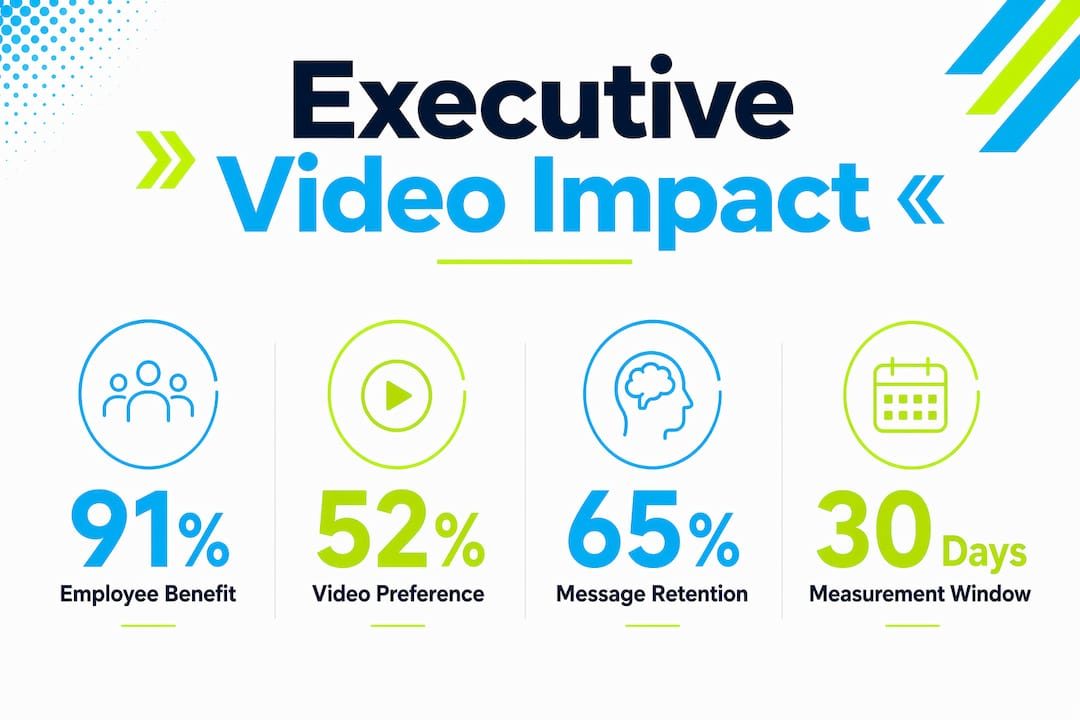
The data is direct. According to LumApps, 91% of employees see clear benefits from accessing video at work, 52% prefer watching video over reading, and 66% would regularly use internal platforms if video content were available. That preference gap between video and text is not marginal. It represents a structural shift in how workforces want to receive information from their leaders.
Vizrt research, reported by CommsToday, adds a retention dimension. Nearly two-thirds of employees say town halls and executive video help them understand business updates and feel aligned with company direction. More critically, 40% say poor-quality video would make them consider leaving the organization. That finding reframes video quality from a production preference to a talent retention factor.
Video also breaks down information silos in ways that email chains cannot. A single well-produced executive update reaches every employee simultaneously, with the same tone and emphasis. In hybrid and remote organizations, that consistency is the difference between a workforce that feels connected to leadership and one that operates on rumor and assumption.
How C-suite leaders can use video strategically
Knowing that video works is one thing. Knowing which formats to use, how often, and with what level of production is where most executive video programs either succeed or stall.
The most effective executive video formats fall into four categories:
- Town halls and all-hands meetings — Live or recorded sessions that address company-wide updates, financial results, or strategic direction. These work best when they include a Q&A segment and are followed by a short recap video for employees who missed the live session.
- Executive update videos — Short, direct recordings from a CEO or senior leader addressing a specific topic: a new policy, a market development, or a response to industry news. These should run between two and five minutes.
- Personal messages — Video messages tied to milestones, recognition, or cultural moments. These carry high trust value because they feel personal rather than institutional.
- Q&A and interview formats — Structured conversations between an executive and a moderator or employee panel. These build leadership credibility more effectively than scripted monologues because they show how leaders think under real conditions.
The Ascendant Group notes that the key for executives is narrative clarity and leadership presence, not simply appearing on camera. Showing up on video without a clear message structure wastes the format’s potential. You need a defined opening claim, a logical middle that supports it, and a close that tells employees what to do or how to feel next.
Pro Tip: Record a 60-second internal test video before your first formal executive production. Watch it back with the sound off. If your body language and facial expression do not match the message you intended, adjust before going to a full production.
Cadence matters as much as format. A monthly executive video that employees can count on builds more trust than a quarterly video that only appears during a crisis. Consistency signals that leadership is engaged, not reactive.
Budgeting and production models for executive video programs
Budget reality shapes every executive video program. The 2026 Wistia State of Video report, based on nearly 1,000 marketers surveyed and analysis of 13 million videos, shows that 40% of video teams plan to increase spend in 2026, with over 30% spending more than $5,000 per production. That signals growing organizational commitment to video quality.
However, eMarketer’s May 2026 analysis of the same Wistia data reveals the other side. 51% of marketing, operations, and leadership teams report flat or declining video budgets, with company size cited as a barrier by 66% and costs by 44%. Most executive teams are being asked to do more with the same resources.
The practical answer is a tiered production model:
| Production tier | Best use case | Approximate investment |
|---|---|---|
| Tier 1: Professional production | Quarterly town halls, annual reports, major announcements | $5,000 and above per video |
| Tier 2: Semi-professional | Monthly executive updates, internal campaign videos | $1,000 to $5,000 per video |
| Tier 3: In-house or DIY | Weekly check-ins, personal recognition messages | Under $1,000 with proper equipment |
The tier you choose should match the audience size, the strategic weight of the message, and the longevity of the content. A CEO message about a merger requires Tier 1. A Friday team update does not.
Scaling globally does not require re-shooting every video. Worldlink’s 2026 localization research confirms that subtitles, voiceovers, and cultural adaptation allow organizations to reach multilingual workforces efficiently without full re-productions. A single well-produced executive video can serve 20 markets with the right localization workflow. That approach protects your production budget while expanding reach.
Pro Tip: Repurpose every major executive video into at least three formats: the full version for your intranet, a two-minute highlight clip for email distribution, and a transcript for employees who prefer reading or need accessibility support.
How to measure the success of executive video communication
Views and attendance numbers are the least useful metrics for executive video programs. They tell you who showed up, not whether the message landed.
Strong communication teams track a different set of indicators:
- Comprehension rate — Post-video surveys or short quizzes that confirm employees understood the key message, not just watched the video.
- Engagement drop-off — At what point in the video do viewers stop watching? A consistent drop-off at the two-minute mark in a five-minute video tells you the message structure needs work.
- Sentiment analysis — Comment sections, reaction tools, and follow-up pulse surveys reveal whether employees feel informed, motivated, or confused after an executive video.
- Action completion — Did employees take the specific action the video requested? Clicked a link, completed a form, attended a follow-up session?
CommsToday’s reporting on internal communication measurement makes the point clearly: town halls are data-rich feedback loops, not one-off events. Every session generates signals about what employees understand, what they are anxious about, and where leadership messaging is falling short. Organizations that treat town halls as measurement opportunities improve their next communication based on real data, not assumptions.
Interactive features accelerate this feedback cycle. Live polls during town halls, Q&A submission tools, and post-event comment threads give employees a voice while giving communication teams the data they need to refine future executive videos.
You can also extend the life and reach of every executive video through repurposing. A recorded town hall becomes a highlight reel for new hires. A CEO update becomes a chapter in your leadership video content library. A Q&A session becomes a source for short-form clips shared on your company LinkedIn page. Each repurposed format reaches a different audience segment without requiring new production time or budget.
Pro Tip: Set a 30-day measurement window for every major executive video. Collect comprehension data in week one, sentiment data in week two, and action completion data by week four. That timeline gives you a complete picture of impact before your next production cycle.
Key takeaways
Executive video communication works because it combines leadership presence, message clarity, and measurable engagement in a format that employees demonstrably prefer over text.
| Point | Details |
|---|---|
| Video preference is decisive | 52% of employees prefer video over reading, making it the strongest internal communication format available. |
| Quality affects retention | 40% of employees say poor-quality executive video would make them consider leaving the organization. |
| Tiered production is practical | Match production investment to message weight: professional for major announcements, in-house for routine updates. |
| Localization multiplies reach | Subtitles and voiceovers let one executive video serve multiple global markets without re-shooting. |
| Measure beyond attendance | Track comprehension, sentiment, and action completion to evaluate whether executive video is actually working. |
What 18 years of B2B video production has taught us about executive communication
Most executives underestimate how much the production environment affects their on-camera performance. We have worked with senior leaders who are compelling in a boardroom but freeze in front of a camera. The difference is almost never confidence. It is preparation and context. When a leader understands the narrative structure of the video before the camera turns on, the delivery changes completely.
The second thing most organizations get wrong is treating executive video as a one-time effort. A single well-produced CEO message does not build trust. A consistent cadence of honest, clear, well-produced videos does. The organizations we have seen get the most from their executive video programs are the ones that treat it as an ongoing communication infrastructure, not a project.
There is also a misconception that high production value means scripted and stiff. The opposite is true. Professional production gives you the technical foundation, good lighting, clean audio, and stable framing, that allows a leader’s natural presence to come through. The goal is never to make an executive look polished. The goal is to remove the technical distractions so the message is the only thing the audience focuses on.
Budget constraints are real, and we respect that. But the tiered approach works. You do not need a full production crew for every video. You do need professional production for the moments that matter most to your workforce and your brand.
— Kicker
How Kickervideo helps C-suite leaders communicate with confidence
Kickervideo has spent 18 years producing B2B video for organizations that need their executive messages to land with clarity and authority. We understand the production, messaging, and strategic considerations that separate a forgettable video from one that genuinely moves an organization forward.
Whether you need a structured B2B video production workflow for a quarterly town hall series or a one-time CEO announcement that needs to reach a global workforce, Kickervideo brings the production expertise and strategic thinking to make it work. We also help teams build repurposing and localization workflows that stretch every production dollar further. If you are ready to build an executive video program that your employees actually trust, professional video services from Kickervideo are the place to start.
FAQ
Why does video matter more than email for C-suite communication?
Video communicates tone, confidence, and sincerity in ways that text cannot. Research shows 52% of employees prefer video over reading, making it the more effective channel for leadership messages that need to build trust.
How often should C-suite leaders publish video content?
A monthly cadence of executive video builds more consistent trust than quarterly or crisis-driven releases. Frequency signals ongoing engagement from leadership rather than reactive communication.
What production quality is needed for executive video?
Production quality should match the strategic weight of the message. Major announcements and town halls warrant professional production, while routine updates can use semi-professional or in-house setups. Vizrt data shows 40% of employees would consider leaving over poor-quality video, so quality is never trivial.
How can executive videos reach a global workforce efficiently?
Localization through subtitles, voiceovers, and cultural adaptation allows a single executive video to serve multiple markets without re-shooting. This approach, supported by Worldlink’s 2026 research, protects production budgets while expanding reach.
What metrics should executives track for video communication success?
Track comprehension rate, engagement drop-off, sentiment, and action completion rather than views alone. These engagement metrics give you a complete picture of whether your message actually landed with your workforce.