Video in Account-Based Marketing Explained for B2B Teams
August 12, 2026 · Video Production Company

Personalized video in account-based marketing triples response rates compared to text-only email outreach, and yet most B2B marketing teams still treat video as an afterthought rather than a strategic priority. Video in account-based marketing explained properly is not just about recording a talking-head clip and hitting send. It covers AI-powered personalization at scale, physical video mailers for high-value accounts, and structured campaign sequencing that drives real pipeline. This guide breaks down every layer of that picture so you can build a video strategy for ABM that actually performs.
Table of Contents
- Key Takeaways
- Video in account-based marketing explained: the foundation
- AI-powered personalization at scale
- Physical video mailers as premium ABM tools
- Video content best practices for ABM campaigns
- My perspective on video as a long-term ABM asset
- Elevate your ABM video strategy with Kickervideo
- FAQ
Key Takeaways
| Point | Details |
|---|---|
| Video triples response rates | Personalized video generates 3x more replies than text emails, making it your highest-leverage ABM channel. |
| AI enables true scale | One recorded template plus a contact dataset produces thousands of unique, personalized videos for individual accounts. |
| Physical mailers bypass digital fatigue | Video presentation boxes reach C-suite decision makers who ignore email and digital ads entirely. |
| Structure determines video performance | A 60 to 90 second format with dedicated segments for context, problem, value, and CTA consistently outperforms longer content. |
| Multi-stakeholder targeting wins deals | Sending personalized video to multiple roles within a single target account accelerates internal consensus and moves deals forward. |
Video in account-based marketing explained: the foundation
Account-based marketing is a B2B strategy where sales and marketing teams align around a defined set of high-value target accounts rather than broad audiences. The focus shifts from generating volume to generating depth. You personalize messaging per account, engage multiple stakeholders within each organization, and coordinate outreach across channels over time.
Traditional ABM channels like email sequences and digital display ads have a structural problem: they are text-heavy, easy to ignore, and feel impersonal even when they include a first name. A decision maker at a Fortune 500 company receives hundreds of cold emails per week. Your carefully written message disappears into the same inbox as everyone else’s.
Video changes that dynamic. Here is why it works where other ABM formats fall short:
- Human presence builds trust. A real face and voice signal that a person invested time in the outreach. Video personalization increases perceived effort and relevance, which directly lowers a buyer’s resistance to engage.
- Audio and visual combine for stronger recall. Buyers remember significantly more of what they see and hear than what they read.
- Personalized video is verifiable. When you record against a prospect’s website or reference their specific business challenge, they know immediately it was created for them.
- Video creates emotion. Even a 60-second clip communicates tone, confidence, and care in ways that text cannot.
The main video types used in ABM include personalized one-to-one outreach clips, explainer videos tailored to an account’s industry or pain point, case study videos featuring similar customers, and physical video mailers sent as tangible premium experiences.
AI-powered personalization at scale
The biggest obstacle B2B marketing teams face with account-based marketing video is scale. Creating a genuinely personalized video for 500 target accounts manually is not realistic. AI video personalization solves that problem directly.
The workflow works like this:
- Record a single base video where you deliver the core message.
- Feed the system a dataset containing each prospect’s name, company, job title, and relevant context.
- The AI clones your voice and lip-sync, generates dynamic backgrounds using each prospect’s website or branded visuals, and renders thousands of unique videos automatically.
- Each recipient receives a video that appears to have been recorded specifically for them, with their name spoken naturally and their company referenced visually.
- You deploy those videos through your CRM, sales engagement platform, or email sequence with personalized thumbnails showing the recipient’s name or website.
The results are measurable. Personalized video generates 3x more responses than text-only emails, and the meeting-to-reply ratio runs approximately 2:1 compared to text, meaning roughly half of positive replies from personalized video sequences convert to discovery calls.
The most advanced teams go further. They use AI-native video workflows that connect to CRM data and update video content dynamically based on where a prospect is in the buying stage. A contact who just visited your pricing page receives a different video than one who opened your product overview last week.
Pro Tip: Avoid the common mistake of using AI personalization only for the name. True personalization references the prospect’s industry challenge, a recent company announcement, or a specific pain point visible on their website. Generic AI video that only swaps a name performs only marginally better than plain text.
The integration of AI into ABM targeting also extends beyond video production. AI analyzes thousands of behavioral signals to identify which accounts are showing active buying intent, so your personalized videos reach the right companies at exactly the right moment. Combining intent data with video personalization is one of the most effective ABM strategies available right now.
Video personalization at scale is not a distant capability. B2B teams are deploying this today with measurable pipeline impact.
Physical video mailers as premium ABM tools
Digital fatigue is real. C-suite executives and senior decision makers at large enterprise accounts have built up significant resistance to email, LinkedIn messages, and digital ads. A physical video mailer reaches them through a completely different channel, one they cannot scroll past or filter into a junk folder.
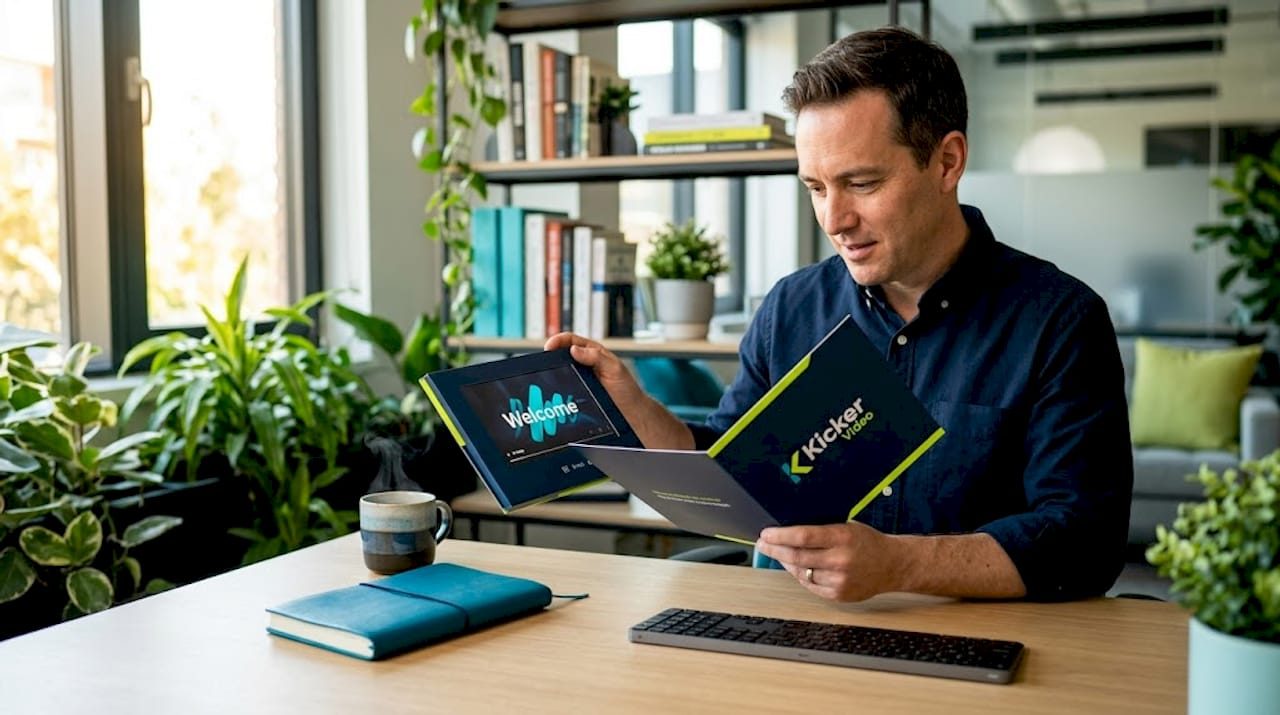
A video mailer is a physical device, typically a printed brochure or presentation box, with an embedded LCD screen and speaker. When the recipient opens it, a branded video plays automatically. Here is what makes them effective in ABM:
- They are impossible to ignore. A physical package lands on a desk. It gets picked up, opened, and shown to colleagues in a way that no digital message replicates.
- They signal serious investment. Sending a premium video mailer to a target account communicates that you view them as a high-value partner, not just a lead.
- They engage multiple stakeholders naturally. A presentation box that plays a compelling video often gets passed around a team, creating internal word-of-mouth at your target account.
- AI now personalizes the spoken content. The latest generation of video mailers uses AI-generated voice to speak each recipient’s name naturally within the video, adding a layer of personalization that feels unexpected coming from a physical device.
- They connect to digital campaigns. Embedded QR codes and NFC triggers in physical mailers push recipients into trackable digital journeys, allowing you to measure engagement and trigger follow-up actions in your CRM.
The physical and digital combination is particularly powerful for enterprise ABM. You send the physical mailer as the initial high-impact touchpoint, then layer digital video and email follow-up on top as the prospect moves through the funnel.
For multi-stakeholder accounts, consider sending multiple mailers to different roles within the same target organization, each with messaging tailored to that person’s priorities. A CFO receives a video focused on financial impact and risk reduction. A VP of Operations receives one focused on efficiency and workflow improvement. This approach builds internal momentum across the buying committee simultaneously.
Video content best practices for ABM campaigns
Producing a video is not the same as producing a video that works. The structure, length, and sequencing of your content directly determines how it performs inside an ABM campaign.
Video length and structure
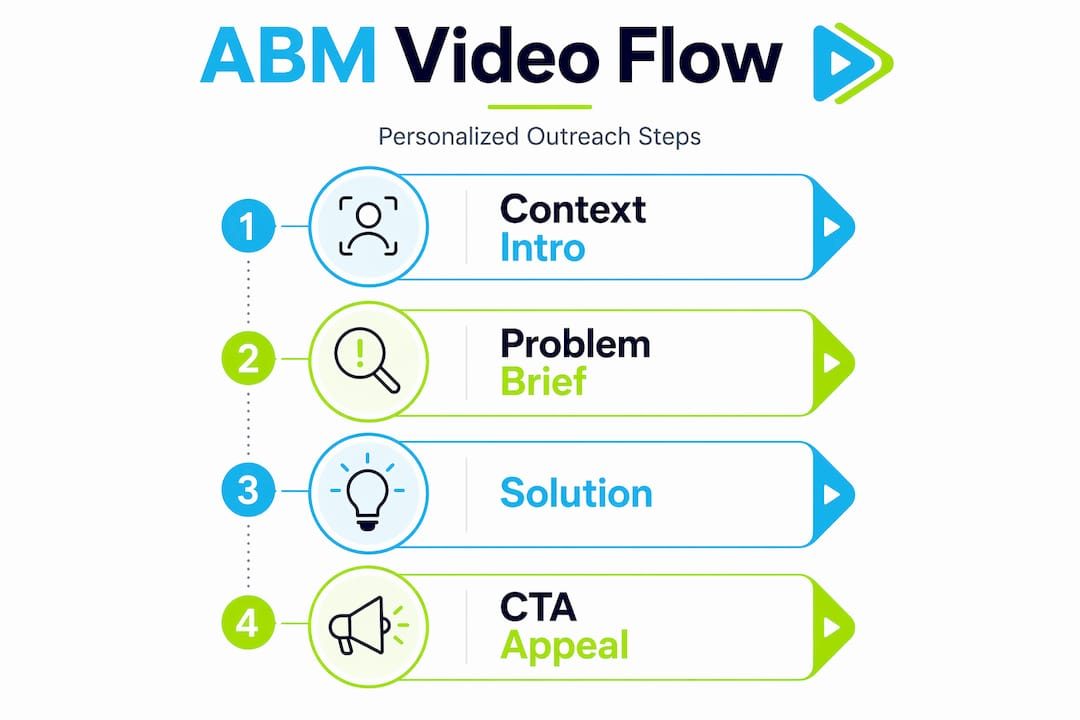
The recommended format for ABM outreach video is 60 to 90 seconds. Engagement drops sharply beyond two minutes, and attention in the first 15 seconds determines whether the viewer continues watching. Use this structure as your baseline:
| Segment | Duration | Purpose |
|---|---|---|
| Context | 15 seconds | Establish who you are and why this video is relevant to them specifically |
| Problem | 20 seconds | Name the challenge they are likely facing without overstating or generalizing |
| Value | 20 seconds | Show how your solution addresses that specific challenge |
| CTA | 10 to 15 seconds | One clear ask, typically a short call or a reply |
Showing a prospect’s website while recording creates immediate relevance. A video that references a specific page, product line, or recent announcement tells the viewer within the first few seconds that this was made for them. That recognition drives watch time.
Messaging across stakeholders
Different roles within your target accounts care about different outcomes. A video messaging strategy for ABM should map your content to each stakeholder group. Technical buyers want specifics about integration and performance. Business leaders want outcomes and ROI. Senior executives want strategic fit and risk reduction.
Use your CRM data to tag contacts by role and assign the appropriate video variant. This is where integrating your video strategy with your overall B2B video marketing approach pays dividends. The accounts you target most aggressively deserve messaging that speaks to the full buying committee, not just the primary contact.
Measuring video performance in ABM
Tie video engagement metrics directly to pipeline data. Track watch rates, click-through rates on CTAs, and reply rates per account, not just per contact. When you see a target account with multiple contacts watching your videos but no reply, that is a signal to escalate with a physical mailer or a direct outreach from a sales leader.
Pro Tip: Test video thumbnails as aggressively as you test subject lines. A thumbnail showing the prospect’s company name or website generates significantly higher open rates than a generic preview frame.
My perspective on video as a long-term ABM asset
I have worked with B2B marketing teams for 18 years, and the pattern I see most consistently is this: teams that treat video as a one-shot tactic get one-shot results. Teams that build video into the relationship over time see compounding returns.
The accounts that convert at the highest rate are the ones that received multiple video touchpoints across different formats. An AI-personalized outreach clip at the prospecting stage. A case study video when they showed buying intent. A physical video mailer when the deal went quiet. Each touchpoint reinforced the relationship rather than just pushing a transaction.
What I find most interesting right now is the shift toward agent-based marketing, where AI-powered digital researchers vet vendors autonomously before any human at the target account gets involved. Your video content, if it is publicly accessible, becomes part of what those agents evaluate. This means your ABM video strategy is no longer just a direct outreach tool. It is increasingly part of your discoverability in an AI-mediated buying process.
The AI-powered targeting capabilities that are now standard in ABM platforms also raise the bar for what personalization means. Accounts that were once difficult to reach because of digital gatekeepers are now being reached through physical video devices that bypass those filters entirely.
My honest advice: stop asking whether video is worth the investment. Start asking whether your video is actually personalized, structured correctly, and delivered across the right combination of channels. That is the question that separates high-performing ABM teams from everyone else.
— Kicker
Elevate your ABM video strategy with Kickervideo
If you are ready to put these principles into practice, production quality and workflow matter more than most teams realize. At Kickervideo, we have spent 18 years helping B2B marketing teams build video programs that drive real pipeline, not just views.
Whether you need a structured B2B video production workflow that integrates with your ABM campaigns, AI-personalized video at scale for your target account list, or remote production capabilities that fit distributed teams, Kickervideo has the experience to deliver it. We work with marketing strategists who understand their accounts and need a production partner that can match that level of precision. Explore how professional video production translates directly into ABM pipeline and reach out to discuss your campaign needs.
FAQ
What is video in account-based marketing?
Video in ABM refers to the use of personalized, targeted video content to engage specific high-value accounts across the buying journey. It includes outreach videos, explainer content, case studies, and physical video mailers tailored to individual accounts and stakeholders.
How does AI personalization work for ABM video?
AI personalization takes a single recorded video and generates thousands of unique versions using voice cloning, dynamic visual backgrounds, and CRM data, so each recipient receives a video that feels created specifically for them.
What is the ideal length for an ABM video?
The most effective ABM videos run 60 to 90 seconds, with a structure of 15 seconds of context, 20 seconds on the problem, 20 seconds on value, and 10 to 15 seconds for a clear CTA. Engagement drops sharply beyond two minutes.
What are video mailers and why do they work for ABM?
Video mailers are physical printed devices with embedded LCD screens that play a video automatically when opened. They work in ABM because they bypass digital overload and reach senior decision makers through a channel that cannot be filtered or ignored.
How do you measure video performance in ABM campaigns?
Track watch rates, CTA click-throughs, and reply rates at the account level rather than the individual contact level. Connecting video engagement data to your CRM and pipeline metrics shows you which accounts are warming and which need a different touchpoint.