
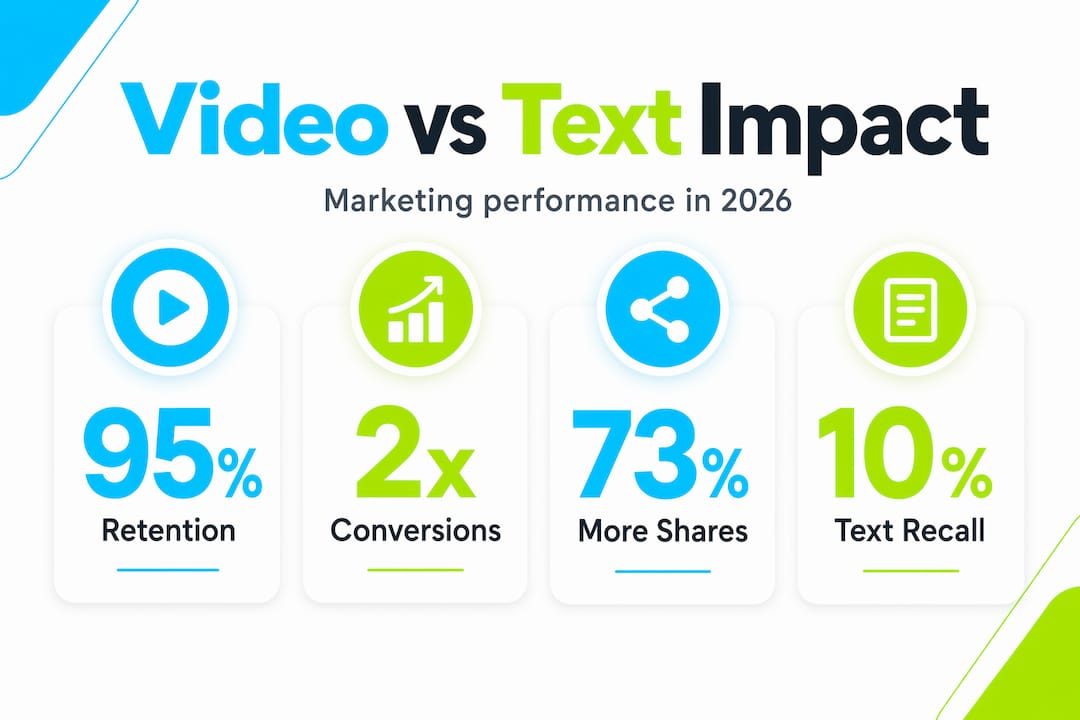
When marketing professionals ask why choose video over text in marketing, the answer goes well beyond audience preference. Video is a multi-sensory format that combines visuals, tone of voice, and movement to communicate in ways that plain text simply cannot match. Viewers retain 95% of a video message compared to just 10% from reading the same content. That gap alone changes how you should think about every piece of content you produce, from landing pages to social campaigns.
Table of Contents
- Key Takeaways
- Why video outperforms text in marketing
- How placement and format shape video effectiveness
- Content quality versus production polish
- Practical ways to use video instead of text
- My take after 18 years in B2B video
- Ready to put video to work for your marketing?
- FAQ
Key Takeaways
| Point | Details |
|---|---|
| Retention gap is massive | Audiences remember 95% of video content versus only 10% from text, making video far more memorable. |
| Placement determines performance | Lightbox modal video placements can double conversion rates compared to inline embedded formats. |
| Quality beats polish | A strong script and clear message outperform high-budget video with weak content every time. |
| Match format to funnel stage | Use explainer videos for awareness, testimonials for consideration, and demos at the decision stage. |
| Video complements, not replaces, text | The most effective content strategies combine video and text rather than treating them as competitors. |
Why video outperforms text in marketing
The technical term for what video achieves is multimodal communication: the delivery of information through multiple channels simultaneously. Text delivers words. Video delivers words, facial expressions, vocal tone, pacing, and visuals at the same time. That combination creates a richer experience and a stronger impression.
Here is why that matters for your marketing results:
- Trust and emotional connection. Video with real people and authentic stories builds customer trust more effectively than text or static images alone. When a prospect watches your spokesperson explain a solution on camera, they read body language and tone. That transparency accelerates the relationship in ways a paragraph cannot.
- Dramatic information retention. Research consistently shows that audiences retain far more from video than from text. The 95% versus 10% retention gap means your message is nine times more likely to stick after a video than after a written explanation.
- Efficient communication of complexity. A product tutorial that would take 800 words to explain in text takes 90 seconds to demonstrate on video. Demos and walkthroughs remove buyer doubt faster because seeing a product work is more convincing than reading about it.
- Conversion rate improvements. Placing product videos on landing pages reduces friction in the buyer journey by answering visual questions that text struggles to address. That friction reduction translates directly into higher conversion rates.
Pro Tip: If you are deciding which pages to add video to first, prioritize the ones where prospects currently drop off. Those are the exact pages where buyer doubt is highest and video can have the fastest measurable impact.
Video content engagement also compounds over time. A well-produced video continues to generate views, shares, and trust signals long after it is published, giving it a longer shelf life than most text-based assets.

How placement and format shape video effectiveness
Here is where a lot of marketers get tripped up. Choosing video over text does not automatically mean better results. The how matters as much as the what. Video content strategy requires deliberate decisions about format and placement, and the data backs this up strongly.
Consider the difference between placement options:
| Format type | Conversion impact | Best use case |
|---|---|---|
| Lightbox modal click-to-play | Very high (+100% lift observed) | Landing pages, key decision moments |
| Inline embedded video | Moderate lift | Blog posts, resource pages |
| Background autoplay video | Neutral to negative | Rarely recommended as primary CTA tool |
| Below-the-fold video | Low | Supporting content, not primary driver |
A lightbox modal video placement increased conversion from 6.5% to 13%, a 100% lift, outperforming every other placement format tested. That result does not happen with a below-the-fold autoplay clip. The same video in the wrong spot can actually hurt performance by distracting visitors and burying your call to action.
Poor video UX, such as autoplay that interrupts a user’s browsing or video that requires scrolling to find, reduces the conversion advantage that video normally holds over text.
Different formats also serve different stages of the buyer journey. Explainer videos work well at the awareness stage where you are introducing a concept. Testimonials perform best during consideration when prospects are evaluating trust. Ambient or background videos can set atmosphere but should not carry the persuasion burden alone.
Pro Tip: Before you publish a video on a landing page, test it in a lightbox click-to-play format first. The viewer chooses when to engage, which creates a far better watching experience and consistently produces stronger conversion results than autoplay.
For a deeper look at how placement decisions affect lead generation, Kickervideo has a practical guide on video on your landing page that walks through the specific mechanics.
Content quality versus production polish
There is a persistent misconception in video marketing: that higher production value means better performance. The data tells a more nuanced story.
Production quality matters less than content quality in video marketing effectiveness. Audiences will forgive imperfect lighting or a slightly shaky camera if the content genuinely helps them. What they will not forgive is a beautifully produced video that says nothing useful.
The same research shows that:
- Human voiceovers consistently outperform AI-generated voices in engagement, though the gap narrows when the script is exceptionally well-written and well-paced.
- AI-generated video ads underperform human-made video in persuasion measures, even when AI performs comparably or better in static image ad formats. The argument strength and emotional authenticity in human-created video carry weight that AI currently cannot replicate at the same level.
- Strong scripts and deliberate pacing drive video marketing effectiveness more than camera quality or post-production effects.
What this means practically: your video content strategy should invest in scripting and message development before production equipment. A clear, persuasive script filmed simply beats a vague message filmed expensively. Human connection and authenticity are the ingredients that text simply cannot provide, and they are equally the ingredients that generic or AI-generated video struggles to deliver.
The takeaway for your marketing team is direct. Prioritize the message. Know exactly what you want the viewer to feel, believe, or do after watching. Then build the production around that goal.
Practical ways to use video instead of text
Understanding the advantages of video over text is valuable. Knowing where and how to apply them is what moves the needle for your business. Here is a structured approach to integrating video into your content strategy by funnel stage.
-
Awareness stage: explainer and brand videos. At the top of the funnel, prospects do not know you well. Short explainer videos that address a specific problem your audience faces introduce your brand with more impact than a blog post. Keep these under two minutes and lead with the problem, not your product.
-
Consideration stage: testimonials and case study videos. This is where video content engagement signals become especially valuable. Social proof delivered through a real customer speaking on camera carries more credibility than a written quote. Prospects are evaluating trust here, and video builds it faster.
-
Decision stage: product demos and FAQ videos. Place these on product pages and landing pages where prospects are closest to converting. A demo video addressing buyer doubts removes the final objections that text explanations often leave unresolved. This is where the conversion lift from video is most measurable.
-
Retention and loyalty: personalized and onboarding videos. Video is not only for acquisition. Onboarding videos, personalized thank-you messages, and how-to content improve client retention by making customers feel supported and informed after the purchase.
-
SEO and distribution. Video content boosts time-on-page metrics, which signals engagement quality to search engines. Combine video with supporting text transcripts and descriptions to capture both video and text search intent. Your video marketing strategy benefits when you treat video and written content as partners rather than substitutes.
Pro Tip: Repurpose every video you produce. A two-minute explainer can become a 30-second social cut, a transcript-based blog post, and a series of pull-quote graphics. You multiply the return on every production investment without additional shooting.
The advantages of video over text compound when you apply them systematically across the funnel rather than treating video as an occasional addition to your content mix.
My take after 18 years in B2B video
I have spent 18 years working with B2B marketing teams on video production, and the question I hear most often is some version of: “Should we replace our text content with video?” My honest answer is always the same. No. And yes.
Video is not a replacement for text. It is a more powerful persuasion tool for specific jobs. Text still works well for detailed technical documentation, long-form thought leadership, and SEO-heavy content where readers come to absorb information at their own pace. Where video wins decisively is anywhere you need to build trust quickly, explain something complex visually, or reduce buyer uncertainty at a critical decision point.
What I have seen consistently is that the marketers who get the best results from video are the ones who treat placement and viewer experience as seriously as they treat production. I have watched beautifully made videos fail because they were buried below the fold or set to autoplay against a visitor’s preference. I have also seen simply produced, well-scripted videos double conversion rates when placed correctly with a click-to-play option.
The other thing I want to be direct about: the medium does not do the work for you. A weak message in video format is still a weak message. Before you decide to produce a video, get the message right. Know what objection you are addressing and what action you want the viewer to take. That clarity is what separates video content that generates business from video content that fills a content calendar.
— Kicker
Ready to put video to work for your marketing?
If you are seeing the gap between what your current text content delivers and what well-placed, well-crafted video can do, the next step is building a production process that actually supports your marketing goals.
At Kickervideo, we have spent 18 years helping B2B marketing teams develop video that moves buyers through the funnel. From scripting and strategy through to final production, our work is built around one outcome: measurable marketing performance. Explore how our B2B video production workflow is designed to support your team efficiently, or see why investing in professional video consistently delivers returns that text-only strategies cannot match.
FAQ
Why does video outperform text in retention?
Viewers retain 95% of a video message compared to just 10% from text, because video engages multiple senses simultaneously. That combination of visuals, audio, and motion creates a stronger memory imprint than reading alone.
What is the best video placement for conversions?
Lightbox modal click-to-play videos consistently outperform other formats. Research shows this placement can double conversion rates compared to inline or autoplay video formats.
Does production quality determine video marketing success?
No. Strong scripts and clear messaging drive video performance more than high production budgets. Audiences respond to content that is genuinely useful, and human voiceovers outperform AI voices when persuasion is the goal.
Should video replace text in my marketing strategy?
Video works best as a complement to text, not a replacement. Use video where you need to build trust quickly or explain something visually. Use text for detailed documentation, SEO content, and long-form thought leadership.
How do I measure video content engagement effectively?
Beyond views and clicks, prioritize engagement signals such as watch time, social sharing, and audience response rates. These qualitative metrics are growing in importance as indicators of true video marketing effectiveness.