Why Prioritize Video in Digital Campaigns: 2026 Guide
August 7, 2025 · Video Production Company

If you are still treating video as a “nice to have” in your digital campaigns, the data says you are behind. U.S. digital video ad spend is on track to surpass $80 billion in 2026, growing 11% year over year. That is not a trend. That is a structural market shift. Understanding why prioritize video in digital campaigns matters now more than ever, because the brands pulling ahead are not just using more video. They are using it differently, measuring it more precisely, and letting AI do work that used to take entire teams.
Table of Contents
- Key takeaways
- Why video dominates digital ad spending in 2026
- Video vs. static content: why engagement tells the story
- How AI is reshaping video campaign performance
- Choosing the right video formats for your goals
- Common misconceptions that undercut video performance
- My perspective: video is a structural shift, not a trend
- Ready to build a video strategy that delivers results
- FAQ
Key takeaways
| Point | Details |
|---|---|
| Video dominates ad spend | Digital video now accounts for more than 60% of total TV/video ad budgets, signaling where investment must go. |
| Engagement beats view counts | Track shares, comments, and saves rather than views alone to understand real campaign performance. |
| Short-form drives highest ROI | Short-form video leads all formats at 48.6% ROI, making it your default starting point for campaigns. |
| AI reshapes video workflows | AI is moving from experimental to operational, optimizing creative, targeting, and measurement at scale. |
| Repurposing extends value | One video asset can feed multiple channels and funnel stages when you treat video as a distribution system. |
Why video dominates digital ad spending in 2026
The numbers behind video’s rise are not incremental. For the first time, digital video exceeds 60% of total TV/video ad spend, crossing a threshold that advertisers and media buyers have watched approach for years. This shift reflects something more than audience preference. It reflects where measurement, accountability, and targeting precision have matured.
| Format | 2026 ROI Rank | Top Use Case |
|---|---|---|
| Short-form video | 1st (48.6%) | Awareness, social, cold prospecting |
| Long-form video | 2nd | Mid-funnel education, brand storytelling |
| Live video / webinars | 3rd | Bottom-funnel engagement, lead capture |
| Static image ads | 4th | Retargeting, simple offers |
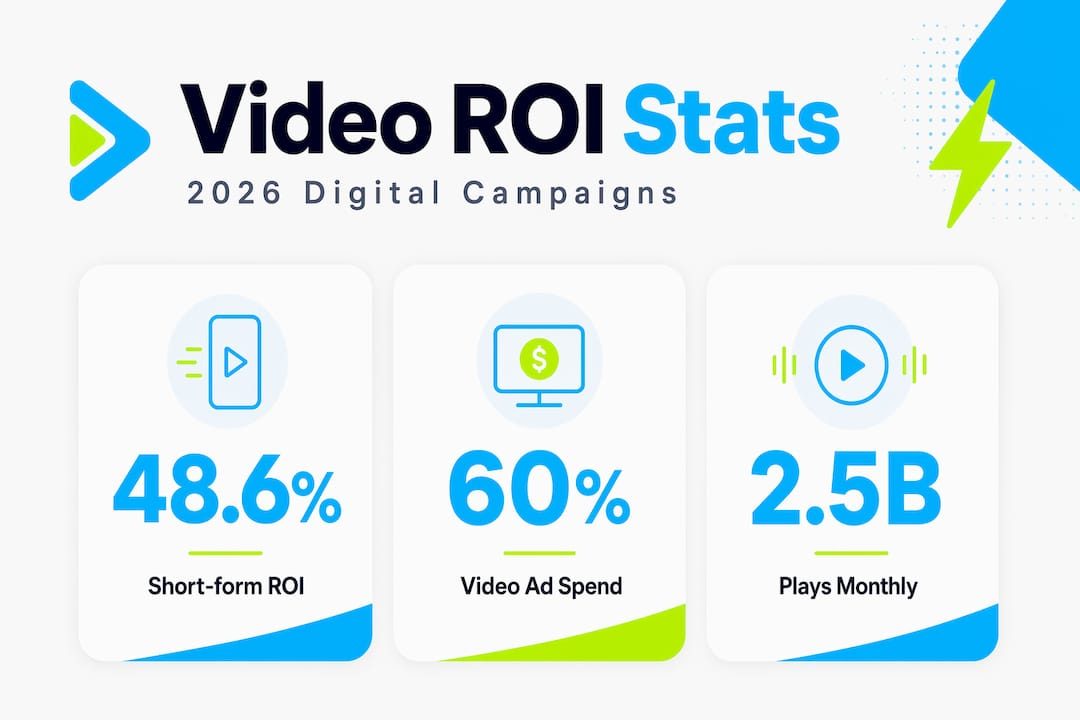
Video hosting platforms now report 2.5 billion video plays across social and owned channels, and that consumption is still climbing. Social video engagement metrics have nearly doubled year over year, pushing marketing teams to allocate more budget to formats that hold attention longer and generate measurable responses.
What is particularly telling is how the success signal has changed. 22% of teams now list social media engagement as their top video success metric, nearly double the prior year. View counts alone no longer tell you whether your video campaign is working. Shares, saves, and comments are replacing them as the primary indicators of real impact.
Video vs. static content: why engagement tells the story
When you compare video vs. static content side by side, the behavioral difference is significant. Video works across multiple senses at once. Motion draws the eye. Sound holds attention. Narrative creates an emotional connection that a static image simply cannot replicate in the same time frame. Video ads outperform static images on click-through rate and cost efficiency, particularly in cold prospecting and top-of-funnel education.

But the deeper story is about dwell time and interaction behavior. People spend more time on pages with video. They engage more. They are more likely to share what they watch than what they read. These behaviors translate directly into pipeline and conversion metrics that matter to your leadership team.
Here are the video formats that consistently drive the strongest engagement:
- Customer testimonials. Real voices from real clients build trust faster than any copy can. They work especially well on product and service pages.
- Product demos. Showing how something works reduces friction in the decision process and answers objections before a prospect even raises them.
- Webinars and live sessions. These formats generate high-intent leads because they require commitment from the viewer. They also create content that can be repurposed long after the live event.
- Short-form social videos. Quick, direct, and optimized for mobile. These are your reach and awareness engine across LinkedIn, YouTube Shorts, and similar platforms.
Homepage videos carry a 24% play rate, higher than product pages, contact pages, or thank-you pages. That data point matters because your homepage is where first impressions are formed. A well-placed video there can do more for your conversion rate than months of copy optimization.
Pro Tip: Place your strongest testimonial or demo video above the fold on your homepage. Do not bury it. If visitors have to scroll to find it, most of them never will.
How AI is reshaping video campaign performance
The role of video in digital marketing has expanded significantly because of AI. This is not about AI-generated video replacing human creativity. It is about AI handling the operational work that used to slow teams down and limit scale.
AI use has shifted from experimental to operational, now reshaping how teams plan, buy, and measure video campaigns. Here is how that plays out in practice:
- Creative optimization. AI tools test multiple versions of a video ad simultaneously, identifying which opening hook, call to action, or thumbnail performs best across audience segments. You get faster learning cycles without manually running split tests.
- Targeting precision. Identity resolution and data integration allow teams to serve the right video to the right viewer at the right moment. This reduces wasted impressions and improves cost efficiency.
- Inventory discovery. AI surfaces placement opportunities across streaming, social, and connected TV that a manual media buyer might miss or undervalue.
- Measurement and attribution. AI connects video engagement signals to downstream outcomes, giving you a clearer line between campaign spend and pipeline contribution.
The key insight here is one many teams miss. Media investment decisions now favor targeting and outcome accountability over creative quality alone. A beautifully produced video that reaches the wrong audience at the wrong time will underperform a simpler video that is precisely targeted and measured.
Pro Tip: Before you increase your video production budget, audit your measurement infrastructure. If you cannot track engagement, watch time, and downstream conversions, you are optimizing blind.
Choosing the right video formats for your goals
Knowing why use video in ads is only half the answer. Choosing the right format and placement is where strategy turns into results. Short-form video leads ROI rankings at 48.6%, making it the default starting point for most campaigns. But short-form is not always the right tool, and knowing when to deploy other formats gives you a clear advantage.
Here is how to align video format with campaign intent:
| Video format | Funnel stage | Primary goal | Key placement |
|---|---|---|---|
| Short-form (under 2 min) | Top of funnel | Awareness, reach | LinkedIn, YouTube Shorts, Instagram |
| Product demo | Mid-funnel | Education, consideration | Product pages, email nurture |
| Customer testimonial | Mid to bottom | Trust, proof | Homepage, proposal follow-up |
| Webinar / live event | Bottom of funnel | Lead capture, conversion | Landing pages, LinkedIn events |
| Case study video | Bottom of funnel | Decision support | Sales decks, email sequences |
Beyond format selection, placement strategy matters just as much. Your homepage, key product pages, and high-traffic blog posts are prime locations for video that can actively contribute to conversion. Social channels, particularly LinkedIn for B2B audiences, amplify reach and generate the engagement signals your algorithm needs to serve content more broadly.
Repurposing is where many teams leave significant value on the table. Teams that repurpose webinars into social clips, replays, and landing page content consistently see higher long-term ROI from the same production investment. One 45-minute webinar can generate dozens of short clips, a recap article, a highlight reel, and multiple social posts. When you treat video as a distribution system across platforms, each asset works harder and lasts longer.
83% of companies share videos on social media, and LinkedIn ranks as the top channel for B2B video sharing. If your repurposing strategy does not include a LinkedIn distribution plan, you are missing your most direct path to professional audiences.
Common misconceptions that undercut video performance
Understanding the video marketing advantages available to you is one thing. Avoiding the mistakes that cancel them out is another. Several misconceptions consistently hold B2B marketing teams back from getting real results with video.
- Measuring success by view count alone. Views tell you how many times a video was loaded. They do not tell you whether anyone watched, engaged, or took action. Success metrics are shifting toward shares, comments, and saves because those signals reflect genuine audience response.
- Treating video as a creative-only exercise. Great creative without distribution, targeting, and measurement infrastructure consistently underperforms. The creative matters, but the system around it matters just as much.
- Skipping repurposing and distribution planning. Producing a video and posting it once is not a video strategy. Distribution and repurposing planning should happen before production begins, not after.
- Underestimating AI’s operational role. Many teams are still using AI for minor tasks while competitors use it to run entire testing and optimization workflows. The gap in performance compounds quickly.
- Overcomplicating the starting point. Marketers face real challenges keeping pace with platform changes and proving ROI. Starting with short-form and one clear distribution channel, then expanding, beats trying to do everything at once.
Pro Tip: Set up a simple video measurement dashboard before your next campaign launches. Track at minimum: play rate, watch-through rate, shares, and any downstream conversion events tied to video touchpoints. You will make better decisions faster.
My perspective: video is a structural shift, not a trend
In my 18 years working with B2B marketing teams on video production, I have seen video go from “something we should probably do” to the single most contested budget line in digital campaigns. What I find interesting is that the teams succeeding with video right now are not necessarily the ones with the biggest production budgets. They are the ones treating video as an integrated performance system rather than a one-off creative project.
I have watched teams spend significant money on polished brand videos that sat on a homepage and generated almost nothing, while leaner teams with clear targeting, a repurposing plan, and consistent short-form output outperformed them quarter after quarter. The lesson there is not that production quality does not matter. It does. The lesson is that quality without strategy produces expensive content that no one ever sees.
What I believe most strongly is this: AI integration is not optional for teams that want to compete with video at scale. The operational advantages are too significant to ignore. Faster testing, smarter targeting, better measurement. These are not marginal gains. They change what is achievable with the same budget.
If you are building your video strategy right now, I would tell you to start with your measurement infrastructure before you add more production. Know what you are going to track. Know what success looks like beyond view counts. Then build the creative around a distribution plan, not the other way around. That sequence changes outcomes.
— Kicker
Ready to build a video strategy that delivers results
At Kickervideo, we have spent 18 years helping B2B marketing teams produce video content that performs across the full campaign lifecycle. We understand that production quality and strategic planning are not separate conversations. They happen together, from the first brief to the final distribution plan.
Whether you are building your first structured video program or scaling an existing one, our team works alongside yours to align format, placement, and measurement with your specific campaign goals. Explore our B2B video production workflow to see how we support marketing teams from strategy through delivery. You can also review our thinking on why investing in video consistently outperforms other digital content investments for B2B brands. If you are ready to move from planning to production, we are here to help you do it well.
FAQ
Why should marketing teams prioritize video over static content?
Video ads outperform static images on click-through rate and engagement because they work across multiple senses simultaneously. Static content cannot replicate the attention-holding and trust-building effect of motion, sound, and narrative combined.
What video format offers the highest ROI for digital campaigns?
Short-form video leads all formats at 48.6% ROI, making it the strongest default choice for most digital campaigns. It works especially well for awareness, social distribution, and cold prospecting.
How does video help boost conversions on a website?
Homepage videos carry a 24% play rate, the highest of any page type, and video placed on high-intent pages gives visitors a faster path to understanding your offer. This directly reduces friction and increases the likelihood of conversion.
How is AI changing the role of video in digital marketing?
AI has moved from experimental to operational, now handling creative testing, audience targeting, and measurement workflows. This means teams can optimize video campaigns faster and connect spend more precisely to performance outcomes.
What metrics should I track to measure video campaign success?
Move beyond view counts and track engagement signals including shares, comments, saves, watch-through rate, and any downstream conversions tied to video touchpoints. Teams prioritizing engagement metrics over views consistently make better creative and distribution decisions.